
Commercial RO Systems
Commercial Reverse Osmosis Systems for High-Volume Water Treatment
Businesses, facilities, and larger properties often need more purified water than a standard residential under-sink system can produce. A commercial reverse osmosis system is built for that gap. It delivers consistent, high-volume output for operations where water quality and daily demand go well beyond a single kitchen tap.
What Is a Commercial Reverse Osmosis System?
A commercial RO system follows the same basic principle as residential RO, scaled up for higher output:
- Feed water enters the system under pressure
- Pre-filters (like sediment filters and carbon stages) protect the membrane from particulate and chlorine damage
- The RO membrane separates purified permeate from concentrated reject water
- Permeate is either stored in a tank or sent directly to the point of use
- Concentrate is routed to drain or managed according to the system design
| Feature | Residential RO | Commercial RO |
|---|---|---|
| Typical use | Drinking and cooking at one or two taps | Businesses, facilities, production, and whole-property use |
| Output | Usually measured in tens of GPD | Hundreds or thousands of GPD |
| Storage | Small pressurized tank | Larger storage tank or dedicated distribution system |
| Demand | Intermittent household use | Higher or more continuous demand |
| Installation | Under a sink | Mechanical room, utility area, or commercial treatment space |
| Pre-treatment | Basic sediment and carbon stages | May require softening, iron removal, carbon, or other pre-treatment |
Shop Commercial RO Systems by Production Capacity
Below we have listed our top RO systems segregated by their production capacity.
400 GPD Light-Commercial RO Systems
The light-commercial 400 GPD system, paired with a 10-gallon pressure tank, sits between a standard under-sink RO unit and a full commercial plant. It's built for customers who need more daily production than a household system offers but don't yet need the output or footprint of a larger commercial installation.
500 GPD Commercial Whole-House RO Systems
The 500 GPD system is AFW's entry point into whole-house commercial RO sized for larger properties or facilities that need a step up in purified-water volume. Sizing it correctly means accounting for the daily production rating, confirming adequate feed pressure, planning storage for periods when demand exceeds instantaneous production, and identifying any pre-treatment the source water requires.
1,000 GPD Commercial RO Systems
The 1,000 GPD system is a mid-range option built for facilities with steady daily demand. This capacity tier also includes replacement membranes, including 2.5-inch by 40-inch and 4-inch by 21-inch elements for customers maintaining an existing system rather than buying new. Membrane dimensions and model numbers vary by housing, so confirm the exact fit against the current system before ordering; not every 1,000 GPD-rated membrane fits every 1,000 GPD housing.
2,000 GPD Commercial RO Systems
A 2,000 GPD commercial reverse osmosis water system is the right fit when 500 or 1,000 GPD production doesn't cover daily capacity needs. At this tier, storage-tank sizing, pumping and distribution, concentrate disposal, feed-water pressure, and operating schedule all become bigger planning factors than they are at lower capacities.
4,000 and 7,000 GPD Systems
The 4,000 and 7,000 GPD systems are AFW's high-capacity commercial RO tier, built for large facilities, commercial properties, and applications that require substantial daily purified-water production. Systems at this scale typically require more planning around available space, drainage, electrical service, storage, and pre-treatment than light-commercial equipment; these are installations worth discussing with AFW directly before purchase.
Commercial RO Membranes and Replacement Components
In addition to complete systems, we also offer replacement Axeon HF1 membranes and supporting components.
Choosing the Correct Commercial RO Membrane
Before ordering a replacement membrane, verify:
- Manufacturer and model
- Membrane size
- Capacity rating
- Low-energy or standard configuration
- Vessel compatibility
- Operating pressure
- Source-water chemistry
- Replacement requirements for the specific housing
Current membrane options include the Axeon HF1-2521 (rated 400 GPD at 150 psi), the Axeon HF1-2540 (rated 1,000 GPD at 150 psi), the Axeon HF1-4021 (rated 1,000 GPD at 150 psi), and the Axeon HF1-4040 (listed at 2,500 GPD). Customers unsure which membrane matches their housing should contact AFW directly rather than order by capacity rating alone.
Storage Tanks and Float Controls
A storage tank separates membrane production from periods of peak demand, so the system isn't limited to producing water only as fast as it's used. AFW's 200-gallon RO storage tank pairs with a tank float valve for automatic up/off control, starting and stopping the system as tank level changes. Whole-house RO storage setups typically also need a delivery pump to bring stored water back up to usable pressure.
Booster Pumps
When incoming pressure or distribution demand requires it, a booster pump helps deliver water from storage and maintain pressure throughout the building. Not every commercial RO installation needs a booster pump; whether one is required depends on incoming pressure, elevation, distance, and building layout. Check out our collection of pumps and controls at Commercial Products.
How to Choose a Commercial RO Water Filter System
Follow the steps below to choose the best commercial RO Water Filter system:
Step 1: Test the Feed Water
Before selecting a system, test for TDS, hardness, iron, manganese, chlorine or chloramine, pH, turbidity, silica (where relevant), and microbiological concerns (where relevant). Feed-water testing is what actually determines membrane selection and pre-treatment needs, not assumptions based on municipal versus well source alone. AFW's Water Test Kits are a starting point for anyone who hasn't tested recently.
Step 2: Calculate Daily and Peak Demand
Daily production (GPD) isn't the same measurement as peak flow. A system rated for 1,000 gallons per day may still fall short during a short, high-demand period without enough storage and distribution capacity to bridge the gap. Plan around gallons per day, gallons per hour, peak flow, storage capacity, operating hours, and recovery rate together, not any single number in isolation.
Step 3: Select Pre-Treatment
Common pre-treatment stages include sediment filtration for suspended particles, carbon filtration for chlorine and taste/odor, water softening for hardness and scale control, and iron and sulfur treatment for well water. Specialty treatment may be needed where source-water testing identifies additional contaminants.
Step 4: Plan Reject-Water Disposal
Commercial RO produces a concentrate (reject) stream alongside purified water. Every installation needs an appropriate drain connection or recovery plan that complies with local requirements before the system goes in.
Step 5: Confirm Pressure and Electrical Requirements
Confirm feed-water pressure, pump requirements, electrical supply, drain connection, storage-tank location, distribution-pump requirements, and available service space before finalizing a system; these determine installation feasibility as much as capacity does.
Commercial RO for City Water and Well Water
Listed below are our city and well water:
Municipal Water
Municipal water commonly carries chlorine, chloramine, hardness, and elevated TDS. Carbon pre-treatment is often necessary to protect the RO membrane from chlorine exposure, particularly on systems running continuous or high-volume flow.
Well Water
Well water may carry iron, manganese, sulfur, sediment, hardness, or low pH, all of which can shorten membrane life if left untreated. AFW's Iron and Sulfur Filters and Sediment Filter Systems cover the most common well-water pre-treatment needs ahead of a commercial RO system.
Not Sure Which Commercial RO System Fits Your Facility?
Test your water and contact AFW for help selecting production capacity, pre-treatment, storage, and replacement components.
-

Axeon HF1-2521 400 GPD Membrane
$209.00The Axeon HF1-2521 low energy RO membrane elements can be used with many commercial RO systems, measure 2.5" x 21", and are rated for 400 GPD @ 150 psi. Made in the USA and have a 1-year warranty. ...MB-2521-HF1$209.00 -

Axeon HF1-2540 1000 GPD Membrane
$329.00The Axeon HF1-2540 low energy RO membrane elements can be used with many commercial RO systems, measure 2.5" x 40", and are rated for 1000 GPD @ 150 psi. Made in the USA and have a 1-year warranty...MB-2540-HF1$329.00 -

1000 GPD Commercial Whole House RO System
$4,149.00Flexeon commercial RO systems provide purified water on a large scale World Class Manufacturing Facility ✓Advance Membrane Technology ✓PrecisiROS-1000$4,149.00 -
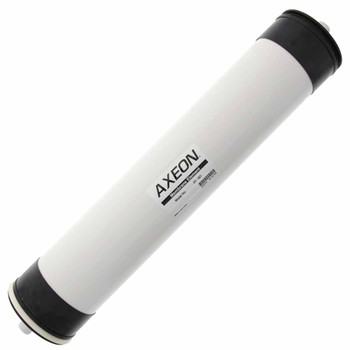
Axeon HF1-4021 1000 GPD Membrane
$349.00The Axeon HF1-4021 low energy RO membrane elements can be used with many commercial RO systems, measure 4" x 21", and are rated for 1000 GPD @ 150 psi. Made in the USA and have a 1-year warranty. ...MB-4021-HF1$349.00 -

Axeon HF1-4040 2500 GPD Membrane
$389.00The Axeon HF1-2540 low energy RO membrane elements can be used with many commercial RO systems, measure 2.5" x 40", and are rated for 1000 GPD @ 150 psi. Made in the USA and have a 1-year warranty. ...MB-4040-HF1$389.00 -

500 GPD Commercial Whole House RO System
$3,919.00Flexeon commercial RO systems provide purified water on a large scale ✓World Class Manufacturing Facility ✓Advance Membrane Technology ✓PrecisROS-500$3,919.00 -

Light Commercial 400 GPD Reverse Osmosis (RO) System w/ 10 Gallon Pressure Tank
$1,899.00This 400 GPD (gallon per day) light commercial RO system is designed to meet the needs of people that require more than a standard undersink RO but not quite the demand and cost of a large commercial...CRO-LT400$1,899.00 -

2000 GPD Commercial Whole House RO System
$6,390.00Flexeon commercial RO systems provide purified water on a large scale ✓World Class Manufacturing Facility ✓Advance Membrane Technology ✓PrecisROS-2000$6,390.00 -

Tank float valve up off for RO system power supply
$127.00Tank float valve to use in open, vented or atmospheric water storage tanks. We use these to regulate when your commercial RO system turns on and off. The wiring can be wired to the RO directly or to...TNK-FLTUO$127.00 -

200 gallon water storage tank for RO water storage in whole house systems
$1,250.00This is the most commonly used storage tank if you are using a whole house RO system. Your RO produces water to fill the tank, then you use a pump to pressurize your home from this tank. We do have...TNK-200$1,250.00 -
On Sale

Pump to deliver water from whole house RO tank to pressurize your home
Standard Price: $1,490.00Sale Price: $1,198.00The SCALA2 is a fully integrated water booster pump that delivers perfect water pressure to all taps. It features a pump, motor, tank, sensor, drive and non-return valve in one compact unit that is...PMP-ScalaStandard Price: $1,490.00Sale Price: $1,198.00 -
Out of stock

7000 GPD Commercial Whole House RO System
$9,899.00Flexeon commercial RO systems provide purified water on a large scale ✓ World Class Manufacturing Facility ✓ Advance Membrane Technology ✓ Precision Manufacturing Tolerances ✓ Made in the USAROC-7000$9,899.00 -

4000 GPD Commercial Whole House RO System
$8,159.00Flexeon commercial RO systems provide purified water on a large scale ✓World Class Manufacturing Facility ✓Advance Membrane Technology ✓PrecisROC-4000$8,159.00