

Drinking Water Filters
Drinking Water Filter Systems for Cleaner Water
Not every water problem calls for a whole-house solution. If you just want better-tasting, cleaner water at the kitchen sink, a drinking water filter system treats water right at the point you use it, without the cost or footprint of a whole-house system.
These are point-of-use systems: they mount under your sink and filter water on its way to a dedicated drinking faucet, rather than treating everything entering your home. Depending on the system, they're built to address sediment, chlorine, tastes and odors, fluoride, arsenic, heavy metals, chloramine, chemicals, increased alkalinity, and bacteria through UV treatment. No single system handles everything, so the right one comes down to what's actually in your water.
Drinking Water Systems by Filtration Stage
2-Stage Systems
For sediment, chlorine, taste, and odor, our 2 Stage 10-inch Drinking Water Filter (DWF-2-SDCB) uses a 1-micron sediment filter followed by a 1-micron carbon block filter. It's built for straightforward filtration, not broad contaminant removal, so a fluoride, arsenic, or heavy metal result on your water test calls for a specialty system instead.
3-Stage Systems
The 3 Stage 10-inch Drinking Water Filter (DWF-3-SDGCCB) adds a granular activated carbon (GAC) stage between the sediment filter and a final carbon block for more carbon contact time and better taste and odor reduction, while sediment upfront protects both carbon stages from clogging.
4-Stage Systems with UV
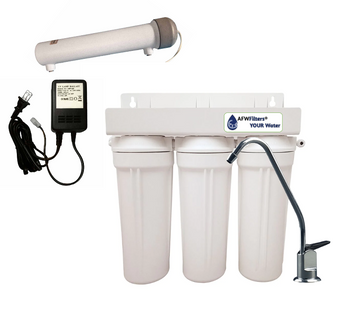
When bacteria or other microorganisms are a concern, the 4 Stage Drinking Water Filter with UV Sterilizer (DWF-4-SDGCCBUV) adds a 1 GPM, 6-watt UV sterilizer after the standard sediment, GAC, and carbon block stages. UV inactivates microorganisms in the water passing through it, not sediment, chemicals, or metals, which is why it's always paired with pre-filtration.
Filters for Specific Contaminants
Standard sediment and carbon filtration doesn't reliably address every contaminant. If your water test shows fluoride, arsenic, chloramine, or elevated heavy metals, a specialty-media system gets better results.
Fluoride and Arsenic
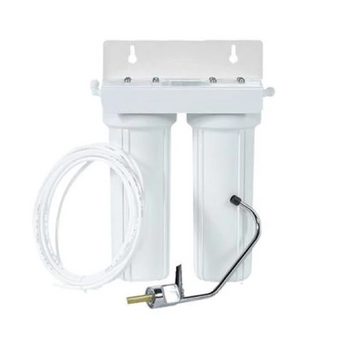
Activated alumina is the specialty media typically used to bring fluoride and arsenic down to safer levels, since standard carbon isn't designed for this. Our 2 Stage Filter for Fluoride, Arsenic, & Heavy Metal Removal (DWF-2-AA55) pairs activated alumina with a GAC/KDF filter for chlorine, chloramines, and heavy metals like lead and mercury. The 3 Stage version (DWF-3-SDAA55) adds a sediment filter ahead of the same two stages.
Bone Char Carbon
A second specialty option for fluoride and arsenic that also handles everyday taste, odor, and chemical reduction. Our 2 Stage Filter with Bone Char Carbon (DWF-2-SDBC) uses a sediment filter followed by bone char carbon. Which specialty media works better depends on your specific water chemistry.
Chloramine, Chemicals, and Heavy Metals
City water treated with chloramine, or water with hydrogen sulfide ("rotten egg" smell), needs a different media combination. Our 3 Stage Filter for Arsenic, Chloramine, Chemical, and Heavy Metal Removal (DWF-3-SDAE55) uses a sediment filter, an AdEdge arsenic-removal stage for both common forms of arsenic, and a catalytic carbon/KDF-85 stage for chlorine, chloramines, herbicides, pesticides, and hydrogen sulfide odor, with KDF-85 also targeting iron. This is a specialized configuration for tested water, not a general-purpose upgrade.
Alkaline Drinking Water Systems
Raising pH is a different goal from removing contaminants, worth knowing before you shop. These systems combine filtration with a media stage that raises pH and alkalinity; they don't soften water or remove dissolved solids the way a water softener or RO system does.
The 3 Stage Filter with Alkalinity Filter (DWF-3-SD55AK) runs a sediment filter, a GAC/KDF filter, and a multi-media alkaline filter that raises pH by roughly 1 to 2 points. The 2 Stage version (DWF-2-55AK) skips the sediment stage, pairing a GAC/KDF55 filter with an Aptera alkaline filter that raises pH by roughly 1 to 3 points in a compact 16" x 12" x 6" footprint. Match your system to what your test shows and what you're actually after: filtration, pH adjustment, or both.
How to Choose the Right Drinking Water System?
Start with your water source. Municipal water is typically already treated for bacteria, usually with chlorine or chloramine, so taste and odor tend to be the main complaints. Well water can carry sediment, iron, manganese, sulfur, hardness, or occasional bacteria that city treatment never addresses. Rather than guessing from there, test for what's relevant by using our water test kits, then match the stages to the problem:
| Water Concern | Suitable System Direction |
|---|---|
| Sediment, chlorine, taste, and odor | 2-stage sediment and carbon system |
| Additional carbon contact | 3-stage sediment, GAC, and carbon-block system |
| Microbiological concern | System with a UV stage |
| Fluoride or arsenic | Activated alumina or bone char carbon system |
| Chloramine, sulfur, or heavy metals | AdEdge or catalytic carbon/KDF system |
| Increased alkalinity or pH | Alkaline filter system |
| Multiple contaminants | Specialty multi-stage system based on your test |
Treat this as a starting point, not a substitute for reading a product's stage breakdown or having your water professionally tested.
Also check installation space: most systems use standard 2.5" x 9.75" cartridges and fit under a typical sink, but confirm the clearance for pulling filters, your plumbing connections, and, for UV systems, a nearby outlet.
FLOWLOK Leak Protection for Under-Sink Filters
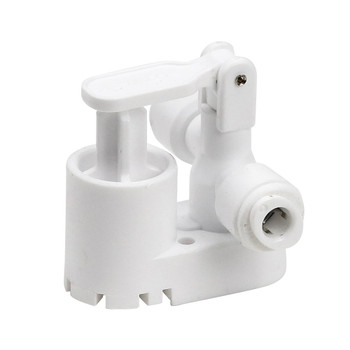
Any under-sink appliance carries some risk of a slow leak going unnoticed. AFW carries two FLOWLOK products to help guard against that: the Flowlok Leak Protection System, which includes a catch tray (roughly 16.75" x 6.25" x 1.5"), and the Flowlok Leak Protection Device on its own. Both use a compressed safety disc that expands on contact with water, tripping a lever that shuts off the supply. No electricity is required. Several multi-stage systems include a FLOWLOK device at no extra cost; check the product page to confirm.
Filtration for Drinking Water: Replacement and Maintenance
How often you replace a cartridge of filtration for drinking water depends on your source water, usage, contaminant load, cartridge type, and water pressure, so there's no single schedule that fits every system. Watch instead for reduced flow, a returning chlorine taste or smell, or visible sediment. Flush new carbon-based cartridges before first use, and check every connection for leaks once it's running. For UV systems, replace the lamp on the schedule in your manual rather than waiting for it to dim, since output can drop before the lamp stops glowing. Our replacement filters and drinking RO filter kits cover most standard sizes.
Find the Right Drinking Water System
Start with your water problem, not the number of filter stages. Test your water and choose the combination built for the contaminants you actually want to address. Unsure whether you need standard filtration, specialty media, UV, or reverse osmosis? Contact AFW Filters, and we'll help you compare your options.
-

2 Stage 10-inch Drinking Water Filter
$99.00The 2 stage drinking water filter features a 1 micron sediment filter and a 1 micron carbon block filter mounted on a bracket; the filter removes sediment, particles, chlorine, tastes, and odors...DWF-2-SDCB$99.00 -

Flowlok Leak Protection System - 1/4"
$29.00FLOWLOK Leak Detector No electricity required Prevent costly water damage Fits most undersink filters Easy to install Includes 2 saftey discs Tray Dimensions: 16.75 x 6.25 x 1.5...FLK-KIT$29.00 -
Flowlok Leak Protection Device - 1/4"
$17.00The FLOWLOK Leak Protection System is a series of products designed to help you take safe guards against possible leaks from you water filtration system. The product shuts off the water supply to...FLK-14$17.00 -

3 Stage 10-inch Drinking Water Filter
$119.00The 3 stage drinking water filter features a 1 micron sediment filter, a GAC filter, and a 1 micron carbon block filter mounted on a bracket; the filter removes sediment, particles, chlorine,...DWF-3-SDGCCB$119.00 -
4 Stage 10-inch Drinking Water Filter with UV Sterilizer
$199.00The 4 stage drinking water filter features a 1 micron sediment filter, a GAC filter, and a 1 micron carbon block filter, and a 1 GPM 6-watt UV sterilizer mounted on a bracket. The system removes...DWF-4-SDGCCBUV$199.00 -
4 Stage 10-inch Drinking Water Filter for Sediment, Lead, Iron, Chlorine, Chemicals, and Odors with UV Sterilizer
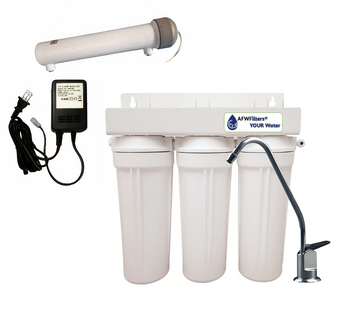
$239.00The 4 stage drinking water filter features a 1 micron sediment filter, a GAC/KDF55 filters, an activated alumina filter, and a 1 GPM 6-watt UV sterilizer mounted on a bracket. The system removes...DWF-4-SD55AAUV$239.00 -

3 Stage 10-inch Drinking Water Filter for Fluoride & Heavy Metal Removal
$199.00The 3 Stage 10-inch Drinking Water Filter for Fluoride, Arsenic, & Heavy Metals features 3 different filters for wide range of contaminant removal not common with most drinking water filters. A 1...DWF-3-SDAA55$199.00 -
2 Stage 10-inch Drinking Water Filter for Fluoride, Arsenic, & Heavy Metal Removal
$169.00Experience the ultimate protection for your drinking water with our 2 Stage 10-inch Drinking Water Filter designed for the removal of fluoride, arsenic, and heavy metals. This advanced filtration...DWF-2-AA55$169.00 -

2 Stage 10-inch Drinking Water Filter with Bone char Carbon for fluoride and arsenic treatment
$149.00The 2 stage drinking water filter features a 1 micron sediment filter and a 1 micron carbon block filter mounted on a bracket; the filter removes sediment, particles, chlorine, tastes, and odors...DWF-2-SDBC$149.00 -

3 Stage 10-inch Drinking Water Filter with Alkalinity Filter
$219.00The 3 Stage 10-inch Drinking Water Filter for Raising Alkalinity features 3 different filters for a wide range of contaminant removal and to increase alkalinity and pH. A 1 micron sediment removes...DWF-3-SD55AK$219.00 -

2 Stage 10-inch Alkaline Drinking Water Filter for Heavy Metals & Increased Alkalinity
$179.00The 2 Stage 10-inch Alkaline Drinking Water Filter for Heavy Metals & Increased Alkalinity features 2 different filters for wide range of contaminant removal and increase alkalinity and pH. The...DWF-2-55AK$179.00 -

3 Stage 10-inch Drinking Water Filter for Arsenic, Chloramine, Chemical, and Heavy Metal Removal
$263.00The 3 Stage 10-inch Drinking Water Filter for Fluoride, Arsenic, & Heavy Metals features 3 different filters for wide range of contaminant removal not common with most drinking water filters. A 1...DWF-3-SDAE55$263.00