
Water Filters Ohio
Ohio Water Changes from Lake Erie to the Ohio River.
Ohio water depends on where you live and which utility serves your address. Cleveland draws from Lake Erie, Columbus uses the Scioto River, Big Walnut Creek and groundwater, while Cincinnati relies on the Ohio River and the Great Miami Buried Valley Aquifer. The hardness difference is real: Columbus reports 98 to 132 mg/L depending on the treatment source, while Cincinnati reports 125 to 138 mg/L, or 7–8 GPG. Some Ohio groundwater systems run harder than either major city supply. A water softener system reduces calcium and magnesium throughout the home; a water purification RO system covers point-of-use drinking and cooking water; a water conditioner for hard water offers a salt-free approach to scale control.
Contaminant Snapshot
Columbus public water system
reported by source
by treatment plant
on every system
Ohio Septic Systems May Restrict Softener Brine Discharge
Ohio rules allow an appropriately sized sewage treatment system to receive water softener brine unless a local permit, health department requirement, manufacturer approval or system condition prohibits it. Ohio EPA guidance for onsite sewage systems also advises against sending water softener discharge into a septic system unless the arrangement is specifically approved.
Ohio EPA also states that brine should not be discharged directly to surface water under its NPDES policy. Residential systems connected to a sanitary sewer may require approval from the wastewater-treatment system owner.
What this means for your household: if your Ohio home uses a septic system, check with the local health department before installing a salt-based water softener. A demand-initiated system or salt-free water conditioner may be a better fit where discharge is limited. Call 785-661-2241 before you order.
What's Actually in Ohio Tap Water?
Cincinnati's 2024 report identifies the Ohio River and Great Miami Buried Valley Aquifer as its two water sources and reports average hardness of approximately 7–8 GPG, alongside monitoring for nitrate, TTHMs and other regulated contaminants. EWG's Ohio database and Columbus utility data identify PFAS compounds, TTHMs, HAA compounds, nitrate, arsenic and other contaminants in Ohio water systems — EWG health guidelines are not the same as enforceable federal limits, so review your local Consumer Confidence Report and EPA compliance information together.
| Contaminant or Concern | Severity | Typical Source |
|---|---|---|
| Hard water scale | CRITICAL | Calcium and magnesium in groundwater, rivers, aquifers and Great Lakes water. |
| Lead from older plumbing | CRITICAL | Lead service lines, solder, brass fixtures and household plumbing. |
| PFAS | HIGH | Historic industrial activity, firefighting foam and contaminated groundwater in affected areas. |
| TTHMs and HAA5 | HIGH | Disinfection reactions involving treatment chemicals and organic matter. |
| Nitrate and arsenic | MODERATE | Agricultural runoff, groundwater conditions and naturally occurring minerals. |
| Chlorine taste and odour | MODERATE | Disinfectant residual maintained through municipal distribution systems. |
How Hard Is Your Ohio Water?
Ohio hardness varies by source and treatment plant. Cleveland's Lake Erie supply is generally moderately hard, Columbus reports approximately 98–132 mg/L by source, and Cincinnati reports approximately 125–138 mg/L. Rural and suburban groundwater systems may be harder than the major city supplies.
Cleveland & Northeast Ohio
Downtown Cleveland, Ohio City, Lakewood, Parma, Euclid — available city-level data
Columbus & Central Ohio
Downtown Columbus, German Village, Clintonville, Dublin, Westerville
Cincinnati & Southwest Ohio
Downtown Cincinnati, Hyde Park, Clifton, Norwood, Covington
Toledo & Northwest Ohio
Downtown Toledo, Old West End, Perrysburg, Sylvania — by local utility and source
Dayton & Groundwater Communities
Downtown Dayton, Kettering, Beavercreek, rural Montgomery County
Note: Legend — 0–3.5 GPG soft · 3.5–7 GPG moderately hard · 7–10.5 GPG hard · above 10.5 GPG very hard. Columbus and Cincinnati publish official hardness figures by source or treatment plant. The actual number for your home depends on the utility, treatment zone and, in some communities, the groundwater source.
Ohio Water Quality by Area & Recommended Solution
| Neighbourhood / Area | Source / Utility | Hardness | Key Concerns | Severity | Recommended Bundle |
|---|---|---|---|---|---|
| Downtown Cleveland & Ohio City | Cleveland Water, Lake Erie | ~7 GPG (available data) | Hardness, lead from older plumbing, TTHMs | HIGH | 40k Softener + RO System |
| Lakewood, Parma & Euclid | Cleveland regional system, Lake Erie | ~7 GPG (available data) | Hardness, lead, chlorine taste, TTHMs | HIGH | 40k Softener + RO System |
| Downtown Columbus & German Village | Columbus Division of Water, Scioto River & Big Walnut Creek | 98–132 mg/L | Hardness, PFAS data, TTHMs, nitrate | HIGH | 48k Softener + RO System |
| Dublin, Westerville & NE Columbus | Columbus municipal supply & groundwater | 98–132 mg/L (confirm locally) | Hardness, PFAS data, chlorine taste | HIGH | 48k Softener + Carbon System |
| Downtown Cincinnati & Hyde Park | Greater Cincinnati Water Works, Ohio River & GMBVA | 125–138 mg/L | Hardness, TTHMs, nitrate, chlorine taste | HIGH | 48k Softener + RO System |
| Rural Ohio & private-well communities | Groundwater & local aquifers | Test required | Hardness, iron, manganese, nitrate, arsenic, bacteria | SEVERE where untreated | 64k Softener + Water Test Kit |
Note: Source: Cleveland Water Department, Columbus Division of Water, Greater Cincinnati Water Works consumer confidence reports, and EWG Ohio utility data, 2024–2025.
Six Reasons Ohio Tap Water Needs Treatment
Ohio does not have one statewide water profile — treatment needs depend on whether you're on Lake Erie, a river system, treated groundwater, or a private well.
Hardness Varies by Water Source
Lead Risk Comes from Older Plumbing
PFAS Conditions Are Location-Specific
TTHMs and HAA5 Can Form During Disinfection
Nitrate and Arsenic Can Affect Groundwater
Septic & Private-Well Homes Need a Different Plan
Water Softener Systems for Ohio Homes
Ohio households with hard municipal water or groundwater can benefit from a properly sized water softener system. Homes connected to septic systems should confirm brine-discharge requirements before choosing a salt-based model.
View all softeners →
40k Water Softener System with Fleck 5600 and 10% Resin
A compact option for smaller Ohio homes or households with moderate hardness, including some Cleveland and Columbus service areas. Confirm hardness and household size before selecting the capacity.

48k Water Softener System with Fleck 5600SXT and 10% Crosslink Resin
A practical fit for many two-to-four-person households with moderate to hard Ohio water. Demand-metered regeneration can help avoid unnecessary cycles and reduce salt use.

64k Water Softener System with High-Capacity Resin
Designed for larger Ohio households or private-well homes where hardness, iron or manganese increases the treatment demand. Test well water before choosing a combination system.
Salt-Based Water Softener System vs. Salt-Free Water Conditioner — Which Fits an Ohio Home?
Ohio customers should check local wastewater and septic rules before installing a salt-based system. A properly sized system may be accepted by an approved sewage-treatment system, but local restrictions can apply.
Salt-Based Water Softener System
- Removes calcium and magnesium through ion exchange
- Stronger choice for very hard groundwater and visible scale
- Protects plumbing and appliances throughout the home
- Demand-initiated models can reduce unnecessary discharge
- Requires salt, a brine tank and wastewater or septic discharge
- Must comply with local sewer, septic or health-department requirements
Salt-Free Water Conditioner for Hard Water
- Conditions hardness minerals to help reduce scale adhesion
- Useful for households that prioritise no salt and low maintenance
- Does not require salt purchases or regeneration wastewater
- Avoids chloride-rich regeneration brine
- Does not physically remove calcium and magnesium
- May be suitable where salt discharge is restricted
Water Purification RO Systems for Ohio Drinking Water
A softener addresses hardness. It does not provide broad treatment for lead, PFAS, nitrate, arsenic, TTHMs or HAA5. A water purification RO system can provide treated water at the kitchen tap for drinking and cooking.
View all RO systems →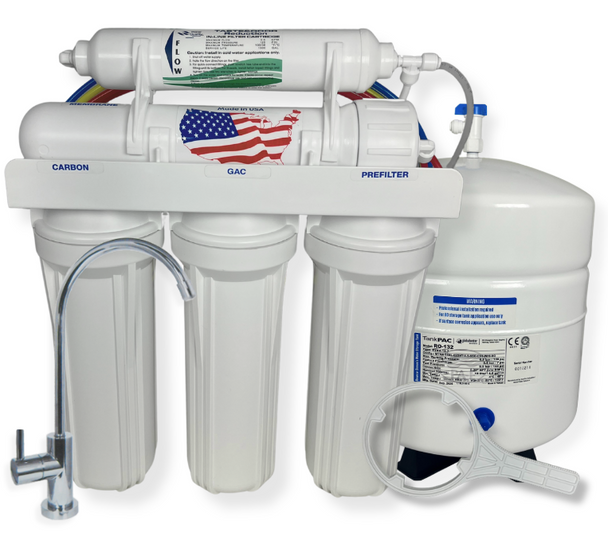
RO Zoi Alpha Pure — 5-Stage Water Purification RO System
A five-stage under-sink reverse-osmosis system for households seeking treated drinking and cooking water. May be relevant for older homes, private wells or confirmed dissolved contaminants, subject to the product's documented performance.

50 GPD NSF-Certified RO Membrane for Ohio Water Systems
A replacement membrane option for compatible standard 1812 under-sink RO systems. Confirm the existing system model, membrane size, fittings and replacement schedule before ordering.
6-Stage UV Zoi Gamma Pure Reverse Osmosis System
A six-stage reverse-osmosis system with UV treatment for households seeking an additional point-of-use treatment stage. May suit private-well homes, but well water should be tested first and pretreatment may be required.
Water Conditioners for Hard Water in Ohio
Water conditioners for hard water can help Ohio households seeking scale control without salt, brine discharge or a regeneration cycle. They do not remove calcium and magnesium in the same way as an ion-exchange water softener system, so they may not be suitable for very hard groundwater.
View all conditioners & whole-house filters →
Scale Sentry Salt-Free Water Conditioner for Ohio Homes
A salt-free option for households that want scale-control support without purchasing salt or sending chloride-rich brine to a wastewater or septic system. Uses specialised scale-prevention media and does not require salt regeneration.
AFW City-Pro 48k Water Conditioner for Hard Water and KDF Media
Combines Purolite resin with KDF media to address hardness alongside selected taste, odour and metals concerns. Confirm the current media configuration and product claims before ordering.

Whole-House Catalytic Carbon Filter for Ohio Taste and Odour
Can help reduce chlorine taste and selected disinfection byproducts before water reaches household fixtures. Does not replace a softener for hardness or an RO system for contaminants requiring point-of-use dissolved-solids reduction.
Why Ohio Homeowners Choose AFW Filters
Since 1998, we've matched thousands of homeowners to the right system for their specific water — not a generic recommendation.
We Start with Your Water Source
Cleveland, Columbus and Cincinnati use different surface-water sources, while many Ohio suburbs and rural communities rely on groundwater. We ask about your utility or private well before recommending equipment.
We Account for Septic & Discharge Requirements
Ohio rules allow some approved sewage-treatment systems to receive softener brine, but local health departments, permits and system conditions can restrict discharge. We help you compare demand-initiated softeners with salt-free conditioners before you buy.
We Separate Scale Control from Drinking-Water Filtration
A water softener system is designed for calcium and magnesium. A water purification RO system is designed for point-of-use drinking-water treatment. Carbon systems address taste and odour. We match the product to the actual water concern.
120-Day Money-Back Guarantee
AFW Filters offers a 120-day money-back guarantee for eligible direct purchases, subject to the current guarantee terms. Review the conditions before ordering.
What Ohio Customers Say
We wanted to improve our home’s water quality and find a system that could handle sediment and other common water concerns. The available filtration options made it easier to choose what worked for us.
Our main priority was getting better-tasting drinking water for the family. We found a suitable filtration system and appreciated having different options available.
I was researching water filtration systems for our Ohio property and came across this selection. There were options for different water concerns, which made the research process easier.
Ohio Water Filter FAQ
Ohio homeowners need different treatment depending on whether their home receives Lake Erie water, river water, treated groundwater or private-well water.
How hard is Ohio tap water?
Do I need a water softener system for an Ohio home?
What size water softener system do I need in Ohio?
Is a water purification RO system useful for Ohio water?
Does a water softener remove lead or PFAS?
Are water conditioners for hard water better than salt-based softeners?
Are water softeners restricted in Ohio?
Does AFW Filters ship water softeners and filters to Ohio?
Tell Us Your Ohio City and Water Source. We'll Size the Right System.
Whether you live in Cleveland and receive Lake Erie water, are in Columbus reviewing a 98–132 mg/L hardness range, reside in Cincinnati and receive Ohio River or aquifer water, or rely on a private well in rural Ohio, choosing the right treatment starts with knowing what is in your water. We'll help you choose a water softener system, water purification RO system or water conditioner for hard water based on your water hardness, household size, water source and treatment needs.