
Water Filters Denver
Denver's Mountain Snowmelt Is Only Moderately Hard. The Real Problems Are Lead Lines and Chloramine.
Denver Water treats snowmelt from the South Platte, Blue and Fraser river basins at four plants for 1.5 million people. Hardness averages a modest 5.2 GPG, but homes built before 1951 may still sit on one of the 60,000 to 64,000 lead service lines Denver Water is replacing, chloramine disinfection leaves byproducts, and Aurora's harder water and Commerce City's PFAS history change the picture across the metro. AFW Filters matches every Denver-area home to the right water purification RO system, water conditioner for hard water or water softener system.
Contaminant Snapshot
about 25% of Colorado
(2.8 to 6.8 GPG)
replaced since 2020
money-back guarantee
What's in Denver Tap Water?
| Contaminant | Severity | Denver Level | Source | Best Treatment |
|---|---|---|---|---|
| Lead (service lines) | CRITICAL in pre-1951 homes | 90th percentile 3.6 to 4 ppb; 7 of 457 homes above the 15 ppb action level in early 2024, highest 44.6 ppb | Customer-owned lead service lines, pre-1987 solder, pre-2014 fixtures | RO at the kitchen tap |
| Disinfection byproducts (TTHMs, HAA5) | HIGH | TTHMs 16.4 to 64.7 ppb and HAA5 7.7 to 37.2 ppb in single samples (2024) | Chloramine reacting with natural organic matter | Catalytic carbon or RO |
| Chloramine | MODERATE | Maintained throughout the system | Disinfectant added at the plants | Catalytic carbon |
| Hardness | MODERATE (HIGH in Aurora) | 5.2 GPG average in Denver Water; 8.0 GPG average in Aurora | Calcium and magnesium from the watersheds | Water conditioner for hard water or softener |
| PFAS | MODERATE (HIGH history in Commerce City) | Not detected in Denver Water's UCMR 5 testing; found in South Adams County wells in 2018 | Firefighting foam, industry | RO or whole-house PFAS system |
| Uranium, radium, arsenic | MODERATE | Uranium up to 1.4 ppb, arsenic up to 0.8 ppb at Marston; radium up to 2.1 pCi/L at Moffat | Natural deposits, mine drainage | RO |
How Hard Is the Water in Your Part of the Denver Metro?
Denver Water is 100% mountain surface water, so it starts low in minerals and lands in the moderate range. Aurora Water treats its own supply at the Wemlinger and Griswold plants and runs harder, and Commerce City draws from wells along the South Platte, where PFAS rather than hardness is the headline.
| Area | Communities | Utility & Source | Hardness |
|---|---|---|---|
| Denver & Denver Water suburbs | City of Denver plus distributor districts such as Bow Mar, Columbine and Platte Canyon | Denver Water: South Platte, Blue River, Fraser and Williams Fork supplies; Foothills, Marston, Moffat and Northwater plants | 2.8 to 6.8 GPG, 5.2 average |
| Aurora | Aurora | Aurora Water: Wemlinger and Griswold purification facilities | 5.1 to 11.6 GPG, 8.0 average |
| Commerce City | Commerce City and parts of unincorporated Adams County | South Adams County Water and Sanitation District: 13 wells, Klein Water Treatment Facility | Not published in the sources reviewed; confirm with SACWSD |
Legend: 0 to 3.5 GPG soft · 3.5 to 7 moderate · 7 to 10.5 hard · 10.5+ very hard. Sources: Denver Water 2025 Water Quality Report (2024 data) and Aurora Water 2026 Water Quality Report. Figures converted from mg/L at 17.1 mg/L per grain.
Six Reasons Denver Tap Water Needs Treatment
Lead Service Lines in Pre-1951 Homes
Disinfection Byproducts
Chloramine Throughout the System
Scale at pH 8.8, and Harder Water in Aurora
PFAS History in Commerce City
Trace Uranium, Radium and Arsenic
Denver Water by Neighborhood and Recommended Setup
| Neighborhood | Source | Hardness | Key Contaminants | Severity | Recommended Bundle |
|---|---|---|---|---|---|
| Older central neighborhoods: Capitol Hill, Baker, Highland, Park Hill, Washington Park | Denver Water | 2.8 to 6.8 GPG | Likely lead service lines in pre-1951 homes, DBPs, chloramine | HIGH | Gold Seal RO + catalytic carbon |
| Newer Denver neighborhoods and Denver Water suburbs (Littleton-area districts) | Denver Water | 2.8 to 6.8 GPG | DBPs, chloramine, scale at pH 8.8 | MODERATE | Salt-free conditioner + RO system |
| Aurora | Aurora Water | 5.1 to 11.6 GPG | Hardness, DBPs | MODERATE TO HIGH | 32k to 40k softener + RO system |
| Commerce City | SACWSD wells | Confirm with SACWSD | PFAS history, past 1,4-dioxane | HIGH | RO system + PFAS whole-house |
Water Purification RO Systems for Denver Drinking Water
Denver's priorities are lead from older service lines, chloramine byproducts and trace radionuclides, which a softener can't touch. An under-sink RO system reduces up to 95 to 99% of dissolved contaminants at the tap.
View All RO Systems →
5-Stage PT-505 Vertex Gold Seal Certified Reverse Osmosis System 50 GPD
Best for pre-1951 homes in the Lead Reduction Program. A permanent, certified step up from the pitcher filter, for homes on Denver Water's lead inventory.
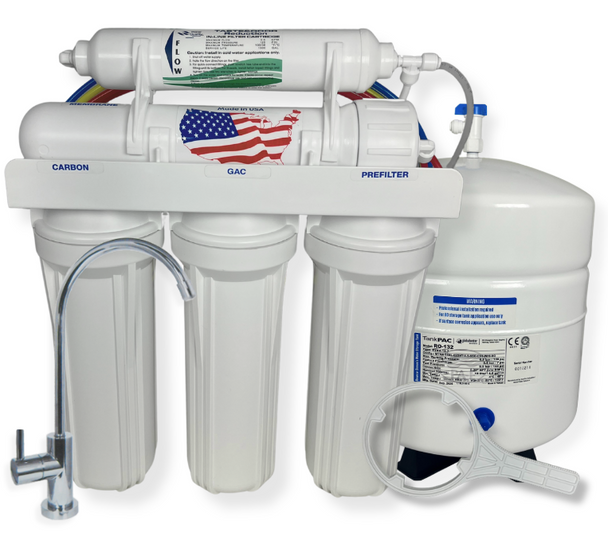
5-Stage Zoi Alpha Pure Reverse Osmosis System
Best everyday drinking water system. Reduces chloramine byproducts, uranium, radium and arsenic for drinking and cooking water.

Whole House PFAS Water Treatment System 8 GPM Flow Rate
Best for whole-home PFAS (Commerce City). ResinTech PFAS-selective resin treats every tap, not just the kitchen. Pair it with RO for drinking water.
Water Conditioners for Hard Water in Denver
At 5.2 GPG, most Denver Water homes don't need a full softener. A salt-free conditioner stops scale on fixtures and water heaters with no salt and no drain line.
View All Salt-Free Conditioners →
Scale Sentry Salt-Free RESIDENTIAL Home Water Conditioner
Best salt-free option for Denver Water homes. Whole-home scale prevention matched to Denver's moderate hardness. Not recommended where water carries iron.

Scale Sentry RESIDENTIAL Salt-Free Home Water Conditioner with HIGH-FLOW Radial Flow Carbon Prefilter
Conditioner plus carbon prefilter. Adds a carbon stage for disinfectant taste and odor ahead of the conditioner.

ScaleMaster HardWater Wizard RW10 Electronic Water Conditioner — 1-Inch Pipe
Best budget option for tankless water heaters. Electronic conditioner rated for water up to 40 grains, with no salt and no maintenance.
Salt-Free Conditioner vs. Salt-Based Softener in the Denver Metro
Salt-Free Water Conditioner for Hard Water
- Stops scale from sticking; minerals stay in the water
- The best fit for Denver Water's 2.8 to 6.8 GPG
- No salt, no drain, low maintenance
- Works without a drain line, good for condos and townhomes
Salt-Based Water Softener System
- Removes calcium and magnesium completely
- Worth it in Aurora, where hardness reaches 11.6 GPG
- Soft feel on skin and hair, less soap
- Needs salt and a drain connection
Water Softener Systems for Aurora and Harder Denver-Area Water
Aurora averages 8.0 GPG. A family of four there uses about 2,400 grains a day, so a 32,000 to 40,000 grain unit runs roughly two weeks between regenerations.
View All Water Softeners →
40k Water Softener with 10% Resin and Fleck 5600SXT Controller, Pentair Tank
Best for most Aurora homes. Metered on-demand regeneration sized for Aurora's 5.1 to 11.6 GPG and a family of 3 to 5.

Upgraded 1 Cubic Foot (32k) On Demand Whole Home Water Softener with 10% Crosslink Resin, Pentair Tank
Best compact softener for smaller households. Right-sized for 1 to 3 people on Aurora water, or anyone in Denver who wants full soft water.

Abundant Flow Water Built Fleck 5600SXT 48,000 Grain Water Softener with Upflow Carbon Filter (10% Resin with Carbon), Pentair Tank, Flex Line Included
Softener and carbon in one package. Softens and treats disinfectant taste in one install. Running carbon ahead of the resin also protects it.
Whole-House Chloramine Filters for Denver Homes
Denver Water keeps chloramine in the water across 3,000 miles of mains, so it reaches every shower and faucet. Catalytic carbon is the media made to remove it, and it's the second half of the "Gold Seal RO + catalytic carbon" setup for older central neighborhoods.
View All Catalytic Carbon Systems →
GreenFlo Catalytic Carbon 15 Upflow System
Best for pre-1951 homes in Capitol Hill, Park Hill and Washington Park. Upflow design with no backwashing and no wastewater. Pair it with the Gold Seal RO above for whole-house chloramine treatment and certified drinking water at the kitchen tap.

Catalytic Carbon 56SXT-10% Combo Package: Fleck 5600SXT 48,000 Grain Water Softener with Upgraded Catalytic Carbon Upflow Filter, Black, Pentair Tank
Best for Aurora: hardness and chloramine in one install. A 48k softener and a catalytic carbon upflow tank shipped together. At Aurora's 8.0 GPG, a family of four uses about 2,400 grains a day, so the softener runs nearly three weeks between regenerations.

20-Inch 2 Stage Whole House Water Filter — Sediment & Catalytic Carbon Filtration
Budget cartridge option for condos and townhomes. Sediment and catalytic carbon cartridges in two 20-inch housings for chlorine, chloramine, taste and odor. Sized for homes with 2 to 4 bathrooms, and you swap cartridges instead of backwashing.
Why Denver Homeowners Choose AFW Filters
We Tell You When You Don't Need a Softener
Denver Water averages 5.2 GPG, so we often recommend a conditioner and an RO system instead of a big softener.
We Know the Metro's Utilities
Denver Water, Aurora Water and South Adams County each deliver different water, and we size to yours.
Real Water Experts by Phone
Call 785-661-2241, weekdays 8am to 4pm CT, and we'll go through your utility report with you.
120-Day Money-Back Guarantee
If the system isn't right for your water, we make it right.
Reviews from AFW Filters Customers
“Water output is great. Never thought I could install the whole setup myself, but the manual and videos are very clear.”
“Lowest price and still the best softener we could find. Quick shipping, and installation took just a couple of hours.”
“Service was great, documentation was good, and shipping was fast and well protected.”
Frequently Asked Questions
Is Denver water hard?
Do I need a water softener system in Denver?
Is a water purification RO system worth it in Denver?
How do I know if I have a lead service line?
Should I keep using the Denver Water pitcher filter?
Does Denver water have chloramine, and how do I remove it?
Is there PFAS in Denver tap water?
Will water conditioners for hard water work in Aurora?
Denver Water Changes by Neighborhood and Utility. Get the Setup That Fits Your Home.
A Park Hill bungalow on a lead line, an Aurora home at 8 GPG and a Commerce City household watching PFAS need different setups. AFW Filters has matched homes to the right systems since 1998.
Denver's Mountain Snowmelt Is Only Moderately Hard. The Real Problems Are Lead Lines and Chloramine.
Denver Water treats snowmelt from the South Platte, Blue and Fraser river basins at four plants for 1.5 million people. Hardness averages a modest 5.2 GPG, but homes built before 1951 may still sit on one of the 60,000 to 64,000 lead service lines Denver Water is replacing, chloramine disinfection leaves byproducts, and Aurora's harder water and Commerce City's PFAS history change the picture across the metro. AFW Filters matches every Denver-area home to the right water purification RO system, water conditioner for hard water or water softener system.
Contaminant Snapshot
about 25% of Colorado
(2.8 to 6.8 GPG)
replaced since 2020
money-back guarantee
What's in Denver Tap Water?
| Contaminant | Severity | Denver Level | Source | Best Treatment |
|---|---|---|---|---|
| Lead (service lines) | CRITICAL in pre-1951 homes | 90th percentile 3.6 to 4 ppb; 7 of 457 homes above the 15 ppb action level in early 2024, highest 44.6 ppb | Customer-owned lead service lines, pre-1987 solder, pre-2014 fixtures | RO at the kitchen tap |
| Disinfection byproducts (TTHMs, HAA5) | HIGH | TTHMs 16.4 to 64.7 ppb and HAA5 7.7 to 37.2 ppb in single samples (2024) | Chloramine reacting with natural organic matter | Catalytic carbon or RO |
| Chloramine | MODERATE | Maintained throughout the system | Disinfectant added at the plants | Catalytic carbon |
| Hardness | MODERATE (HIGH in Aurora) | 5.2 GPG average in Denver Water; 8.0 GPG average in Aurora | Calcium and magnesium from the watersheds | Water conditioner for hard water or softener |
| PFAS | MODERATE (HIGH history in Commerce City) | Not detected in Denver Water's UCMR 5 testing; found in South Adams County wells in 2018 | Firefighting foam, industry | RO or whole-house PFAS system |
| Uranium, radium, arsenic | MODERATE | Uranium up to 1.4 ppb, arsenic up to 0.8 ppb at Marston; radium up to 2.1 pCi/L at Moffat | Natural deposits, mine drainage | RO |
How Hard Is the Water in Your Part of the Denver Metro?
Denver Water is 100% mountain surface water, so it starts low in minerals and lands in the moderate range. Aurora Water treats its own supply at the Wemlinger and Griswold plants and runs harder, and Commerce City draws from wells along the South Platte, where PFAS rather than hardness is the headline.
| Area | Communities | Utility & Source | Hardness |
|---|---|---|---|
| Denver & Denver Water suburbs | City of Denver plus distributor districts such as Bow Mar, Columbine and Platte Canyon | Denver Water: South Platte, Blue River, Fraser and Williams Fork supplies; Foothills, Marston, Moffat and Northwater plants | 2.8 to 6.8 GPG, 5.2 average |
| Aurora | Aurora | Aurora Water: Wemlinger and Griswold purification facilities | 5.1 to 11.6 GPG, 8.0 average |
| Commerce City | Commerce City and parts of unincorporated Adams County | South Adams County Water and Sanitation District: 13 wells, Klein Water Treatment Facility | Not published in the sources reviewed; confirm with SACWSD |
Legend: 0 to 3.5 GPG soft · 3.5 to 7 moderate · 7 to 10.5 hard · 10.5+ very hard. Sources: Denver Water 2025 Water Quality Report (2024 data) and Aurora Water 2026 Water Quality Report. Figures converted from mg/L at 17.1 mg/L per grain.
Six Reasons Denver Tap Water Needs Treatment
Lead Service Lines in Pre-1951 Homes
Disinfection Byproducts
Chloramine Throughout the System
Scale at pH 8.8, and Harder Water in Aurora
PFAS History in Commerce City
Trace Uranium, Radium and Arsenic
Denver Water by Neighborhood and Recommended Setup
| Neighborhood | Source | Hardness | Key Contaminants | Severity | Recommended Bundle |
|---|---|---|---|---|---|
| Older central neighborhoods: Capitol Hill, Baker, Highland, Park Hill, Washington Park | Denver Water | 2.8 to 6.8 GPG | Likely lead service lines in pre-1951 homes, DBPs, chloramine | HIGH | Gold Seal RO + catalytic carbon |
| Newer Denver neighborhoods and Denver Water suburbs (Littleton-area districts) | Denver Water | 2.8 to 6.8 GPG | DBPs, chloramine, scale at pH 8.8 | MODERATE | Salt-free conditioner + RO system |
| Aurora | Aurora Water | 5.1 to 11.6 GPG | Hardness, DBPs | MODERATE TO HIGH | 32k to 40k softener + RO system |
| Commerce City | SACWSD wells | Confirm with SACWSD | PFAS history, past 1,4-dioxane | HIGH | RO system + PFAS whole-house |
Water Purification RO Systems for Denver Drinking Water
Denver's priorities are lead from older service lines, chloramine byproducts and trace radionuclides, which a softener can't touch. An under-sink RO system reduces up to 95 to 99% of dissolved contaminants at the tap.
View All RO Systems →5-Stage PT-505 Vertex Gold Seal Certified Reverse Osmosis System 50 GPD
Best for pre-1951 homes in the Lead Reduction Program. A permanent, certified step up from the pitcher filter, for homes on Denver Water's lead inventory.
5-Stage Zoi Alpha Pure Reverse Osmosis System
Best everyday drinking water system. Reduces chloramine byproducts, uranium, radium and arsenic for drinking and cooking water.
Whole House PFAS Water Treatment System 8 GPM Flow Rate
Best for whole-home PFAS (Commerce City). ResinTech PFAS-selective resin treats every tap, not just the kitchen. Pair it with RO for drinking water.
Water Conditioners for Hard Water in Denver
At 5.2 GPG, most Denver Water homes don't need a full softener. A salt-free conditioner stops scale on fixtures and water heaters with no salt and no drain line.
View All Salt-Free Conditioners →Scale Sentry Salt-Free RESIDENTIAL Home Water Conditioner
Best salt-free option for Denver Water homes. Whole-home scale prevention matched to Denver's moderate hardness. Not recommended where water carries iron.
Scale Sentry RESIDENTIAL Salt-Free Home Water Conditioner with HIGH-FLOW Radial Flow Carbon Prefilter
Conditioner plus carbon prefilter. Adds a carbon stage for disinfectant taste and odor ahead of the conditioner.
ScaleMaster HardWater Wizard RW10 Electronic Water Conditioner — 1-Inch Pipe
Best budget option for tankless water heaters. Electronic conditioner rated for water up to 40 grains, with no salt and no maintenance.
Salt-Free Conditioner vs. Salt-Based Softener in the Denver Metro
Salt-Free Water Conditioner for Hard Water
- Stops scale from sticking; minerals stay in the water
- The best fit for Denver Water's 2.8 to 6.8 GPG
- No salt, no drain, low maintenance
- Works without a drain line, good for condos and townhomes
Salt-Based Water Softener System
- Removes calcium and magnesium completely
- Worth it in Aurora, where hardness reaches 11.6 GPG
- Soft feel on skin and hair, less soap
- Needs salt and a drain connection
Water Softener Systems for Aurora and Harder Denver-Area Water
Aurora averages 8.0 GPG. A family of four there uses about 2,400 grains a day, so a 32,000 to 40,000 grain unit runs roughly two weeks between regenerations.
View All Water Softeners →40k Water Softener with 10% Resin and Fleck 5600SXT Controller, Pentair Tank
Best for most Aurora homes. Metered on-demand regeneration sized for Aurora's 5.1 to 11.6 GPG and a family of 3 to 5.
Upgraded 1 Cubic Foot (32k) On Demand Whole Home Water Softener with 10% Crosslink Resin, Pentair Tank
Best compact softener for smaller households. Right-sized for 1 to 3 people on Aurora water, or anyone in Denver who wants full soft water.
Abundant Flow Water Built Fleck 5600SXT 48,000 Grain Water Softener with Upflow Carbon Filter (10% Resin with Carbon), Pentair Tank, Flex Line Included
Softener and carbon in one package. Softens and treats disinfectant taste in one install. Running carbon ahead of the resin also protects it.
Whole-House Chloramine Filters for Denver Homes
Denver Water keeps chloramine in the water across 3,000 miles of mains, so it reaches every shower and faucet. Catalytic carbon is the media made to remove it, and it's the second half of the "Gold Seal RO + catalytic carbon" setup for older central neighborhoods.
View All Catalytic Carbon Systems →GreenFlo Catalytic Carbon 15 Upflow System
Best for pre-1951 homes in Capitol Hill, Park Hill and Washington Park. Upflow design with no backwashing and no wastewater. Pair it with the Gold Seal RO above for whole-house chloramine treatment and certified drinking water at the kitchen tap.
Catalytic Carbon 56SXT-10% Combo Package: Fleck 5600SXT 48,000 Grain Water Softener with Upgraded Catalytic Carbon Upflow Filter, Black, Pentair Tank
Best for Aurora: hardness and chloramine in one install. A 48k softener and a catalytic carbon upflow tank shipped together. At Aurora's 8.0 GPG, a family of four uses about 2,400 grains a day, so the softener runs nearly three weeks between regenerations.
20-Inch 2 Stage Whole House Water Filter — Sediment & Catalytic Carbon Filtration
Budget cartridge option for condos and townhomes. Sediment and catalytic carbon cartridges in two 20-inch housings for chlorine, chloramine, taste and odor. Sized for homes with 2 to 4 bathrooms, and you swap cartridges instead of backwashing.
Why Denver Homeowners Choose AFW Filters
We Tell You When You Don't Need a Softener
Denver Water averages 5.2 GPG, so we often recommend a conditioner and an RO system instead of a big softener.
We Know the Metro's Utilities
Denver Water, Aurora Water and South Adams County each deliver different water, and we size to yours.
Real Water Experts by Phone
Call 785-661-2241, weekdays 8am to 4pm CT, and we'll go through your utility report with you.
120-Day Money-Back Guarantee
If the system isn't right for your water, we make it right.
Reviews from AFW Filters Customers
“Water output is great. Never thought I could install the whole setup myself, but the manual and videos are very clear.”
“Lowest price and still the best softener we could find. Quick shipping, and installation took just a couple of hours.”
“Service was great, documentation was good, and shipping was fast and well protected.”
Frequently Asked Questions
Is Denver water hard?
Do I need a water softener system in Denver?
Is a water purification RO system worth it in Denver?
How do I know if I have a lead service line?
Should I keep using the Denver Water pitcher filter?
Does Denver water have chloramine, and how do I remove it?
Is there PFAS in Denver tap water?
Will water conditioners for hard water work in Aurora?
Denver Water Changes by Neighborhood and Utility. Get the Setup That Fits Your Home.
A Park Hill bungalow on a lead line, an Aurora home at 8 GPG and a Commerce City household watching PFAS need different setups. AFW Filters has matched homes to the right systems since 1998.