
Water Filters Minnesota
Minnesota Water Can Change from Soft Lake Water to Very Hard Groundwater — Often Within the Same Metro Area.
Minnesota water depends heavily on location and source. Saint Paul Regional Water Services primarily draws from the Mississippi River and the Chain of Lakes, while Duluth relies on Lake Superior. Rochester and many communities outside the major surface-water systems depend more heavily on groundwater. That difference affects hardness and the right treatment strategy — Saint Paul's recent mineral analysis reported 107 mg/L, or 6.25 grains per gallon, while Rochester and many groundwater-dependent communities reach the very-hard range. A water softener system can reduce calcium and magnesium throughout a hard-water home, a water purification RO system handles point-of-use drinking-water treatment, and water conditioners offer a salt-free scale-control option.
Contaminant Snapshot
water-system hardness data
recent mineral analysis
chloride standard
money-back guarantee
Minnesota Is Reducing Chloride from Water Softener Brine
Minnesota's Pollution Control Agency identifies water softener brine as a significant source of chloride entering wastewater treatment plants, septic systems and the environment. This shapes how a softener should be sized and programmed — not whether you're allowed to own one.
230 mg/L Is the Chronic Chloride Standard
Minnesota's chronic chloride water-quality standard is 230 mg/L, and more than 100 wastewater treatment plants have the potential to contribute chloride above the applicable standard — much of it traced back to softener brine and road salt.
Softeners Must Be Sized for Salt Efficiency
Minnesota plumbing guidance requires residential water softeners to be sized, designed and programmed for salt efficiency and minimal chloride discharge. Demand-initiated regeneration using a water meter, hardness sensor or similar control is preferred over unnecessary timer-based regeneration.
You Don't Have to Give Up a Salt-Based Softener
This doesn't mean every Minnesota home must avoid a salt-based softener. It means the system should be correctly sized, programmed for demand-based regeneration and installed according to local requirements — oversizing is the mistake that drives excess chloride.
Not Sure Which Fits Your Home?
Call 785-661-2241 before choosing between a salt-based softener and a salt-free conditioner — we'll size to your actual hardness and household demand, not a generic figure.
What this means for your filtration: a correctly sized, demand-metered softener is still the right answer for genuinely hard Minnesota water — the goal is minimizing unnecessary regeneration, not avoiding ion exchange altogether. Where hardness is moderate and chloride is the priority concern, a salt-free conditioner is worth a look.
What Is Actually in Minnesota Tap Water?
Minnesota's EWG database identifies TTHMs, HAA5, bromodichloromethane, chloroform, radium, nitrate and arsenic among contaminants detected across the state's water systems. Results differ by utility and reporting period, and EWG health guidelines aren't the same as enforceable federal limits. The Minnesota Pollution Control Agency also identifies chloride from road salt and water softener brine as an important concern, particularly in the Twin Cities metro area.
| Contaminant or Concern | Severity | Typical Source |
|---|---|---|
| Hard Water Scale | CRITICAL | Calcium and magnesium in groundwater, carbonate aquifers and some surface-water sources. |
| Chloride | HIGH | Road salt, water softener brine, wastewater discharge and other sources. |
| TTHMs & HAA5 | HIGH | Disinfection reactions involving treatment chemicals and organic matter. |
| Nitrate | MODERATE | Agricultural runoff, septic systems and groundwater conditions. |
| Arsenic & Radium | MODERATE | Naturally occurring minerals in some groundwater systems. |
| PFAS | MODERATE | Historic industrial, firefighting-foam and consumer-product sources in affected areas. |
How Hard Is Your Minnesota Water?
Minnesota hardness can change significantly between surface-water and groundwater systems. Saint Paul's Mississippi River supply is reported at approximately 6.25 GPG in a recent mineral analysis. Duluth's Lake Superior source is classified as soft in available city-level datasets, while Rochester and many groundwater-dependent communities are reported in the hard or very-hard range.
| Sub-Area | Cities & Neighbourhoods | Typical Hardness |
|---|---|---|
| Minneapolis & Inner Twin Cities | Downtown Minneapolis, Northeast Minneapolis, Saint Paul, Highland Park, Como | Approximately 5–7 GPG in available utility data, but confirm by provider |
| Saint Paul Regional Water Services | Downtown Saint Paul, Midway, Highland Park, Como, Frogtown | Approximately 6.25 GPG in recent mineral analysis |
| Rochester & Southeast Minnesota | Downtown Rochester, Elton Hills, Kutzky Park, Northwest Rochester, South Rochester | Approximately 17 GPG in available city-level datasets, with local variation |
| Duluth & Lake Superior Communities | Downtown Duluth, West Duluth, Lakeside, Woodland, Spirit Valley | Approximately 2–3 GPG in available city-level datasets |
| Greater Minnesota Groundwater Communities | Mankato, St. Cloud, Eagan, suburban and rural well systems | Commonly hard to very hard, but confirm with the local utility or water test |
Legend: 0–3.5 GPG soft · 3.5–7 GPG moderately hard · 7–10.5 GPG hard · 10.5+ GPG very hard. Saint Paul's official mineral analysis reports total hardness of 107 mg/L or 6.25 GPG. Statewide comparisons show much higher values in some groundwater communities and lower values around Lake Superior — confirm the actual number for your service address before sizing equipment.
Six Reasons Minnesota Tap Water Needs Treatment
Groundwater Hardness Can Be Very High
Softener Brine Adds Chloride to Wastewater
TTHMs and HAA5 Can Form During Disinfection
Nitrate and Arsenic Can Affect Groundwater Systems
PFAS Concerns Are Location-Specific
Older Plumbing Can Affect Water at the Tap
Minnesota Water Quality by Area & Recommended Solution
| Neighbourhood / Area | Source / Utility | Hardness | Key Concerns | Severity | Recommended Bundle |
|---|---|---|---|---|---|
| Downtown & Northeast Minneapolis | Mississippi River-based municipal supply | Approximately 5–7 GPG | Moderate hardness, TTHMs, HAA5, chlorine taste | MODERATE | 40k Softener + RO System |
| Saint Paul, Highland Park & Como | Saint Paul Regional Water Services — Mississippi River & Chain of Lakes | Approximately 6.25 GPG | Hardness, disinfection byproducts, older plumbing | MODERATE | 40k Softener + RO System |
| Rochester & Southeast Minnesota | Groundwater wells and carbonate aquifer conditions | Approximately 17 GPG | Very hard water, nitrate, arsenic, radium | HIGH | 64k Softener + RO System |
| Duluth, Lakeside & West Duluth | Lake Superior supply | Approximately 2–3 GPG | Chlorine taste, TTHMs, older plumbing | MODERATE | 32k Softener or Carbon System |
| Eagan, Burnsville & Suburban Groundwater Areas | Local municipal wells or blended systems | Confirm locally, often hard to very hard | Hardness, nitrate, chloride, taste and odour | HIGH | 64k Softener + RO System |
| Greater Minnesota Private Wells | Groundwater and local aquifers | Test required | Hardness, nitrate, arsenic, bacteria, iron and manganese | SEVERE WHERE UNTREATED | 64k Softener + Water Test Kit |
Water Softener Systems for Minnesota Homes
Minnesota households with groundwater or very hard municipal water can benefit from a properly sized water softener system. The priority isn't simply removing scale — the system should also regenerate efficiently to reduce unnecessary chloride discharge.
View All Water Softeners →
40k Water Softener System — Fleck 5600, 10% Resin
A compact option for smaller Minnesota homes or households with moderate hardness, including some Minneapolis and Saint Paul service areas. Confirm hardness before choosing a smaller-capacity unit.

48k Water Softener System — Fleck 5600SXT, 10% Crosslink Resin
A practical fit for many two-to-four-person households with hard municipal water or moderately hard well water. Demand-initiated regeneration helps the system respond to actual water use instead of a fixed timer.

64k Water Softener System — Purolite Resin
Designed for larger Minnesota households or areas where groundwater hardness reaches the high or very-hard range. It provides more capacity between regeneration cycles than a smaller system.
Salt-Based Water Softener System vs. Salt-Free Water Conditioner — Which Fits a Minnesota Home?
Salt-Based Water Softener System
- Removes calcium and magnesium through ion exchange
- Stronger choice for very hard groundwater and visible scale
- Protects plumbing and appliances throughout the home
- Requires salt, a brine tank and wastewater or septic discharge
- Demand-initiated regeneration can reduce unnecessary chloride discharge
- Must be sized and programmed for salt efficiency under Minnesota guidance
Salt-Free Water Conditioner
- Conditions hardness minerals to help reduce scale adhesion
- Suitable for households that prioritise no salt and low maintenance
- Does not physically remove calcium and magnesium
- Does not require salt purchases or regeneration wastewater
- Avoids chloride-rich regeneration brine entirely
- May be suitable where moderate scale prevention is acceptable
Water Purification RO Systems for Minnesota Drinking Water
A water softener reduces hardness, but it does not provide broad treatment for arsenic, nitrate, radium, PFAS, TTHMs or HAA5. A water purification RO system can provide treated drinking and cooking water at the kitchen tap.
View All RO Systems →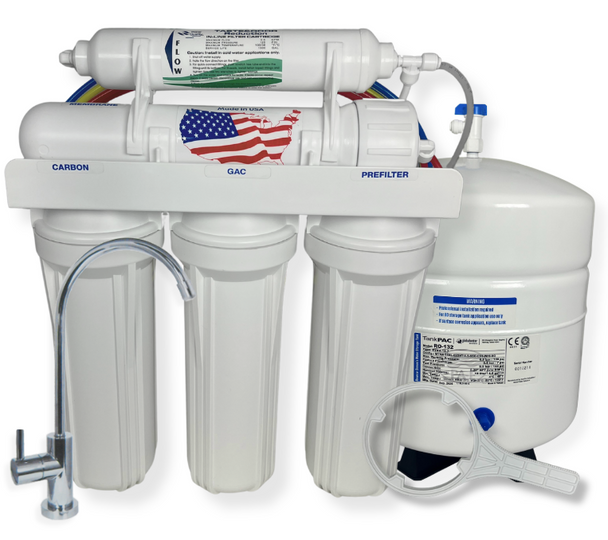
RO Zoi Alpha Pure — 5-Stage Water Purification RO System
A five-stage under-sink reverse-osmosis system for households seeking treated water for drinking and cooking. Match the system's documented contaminant-reduction performance to your local water report or test.

50 GPD NSF-Certified RO Membrane for Minnesota Water Systems
A replacement membrane option for compatible standard 1812 under-sink RO systems. Check the current system model, membrane size, fittings and replacement schedule before ordering.
6-Stage UV Zoi Gamma Pure Reverse Osmosis System
A six-stage RO system with UV treatment for households seeking an additional point-of-use treatment stage. May be relevant for private-well households — well water should be tested first, as pretreatment may be required.
Water Conditioners For Hard Water in Minnesota
Water conditioners for hard water can help Minnesota households that want scale control without salt, brine discharge or a regeneration cycle. They do not remove calcium and magnesium in the same way as an ion-exchange water softener system, so they may not be the right choice for very hard Rochester or private-well water.
View All Conditioners & Whole-House Filters →
Scale Sentry Salt-Free Water Conditioner for Minnesota Homes
A salt-free option for households that want scale-control support without salt purchases or chloride-rich regeneration brine. Salt-free conditioners do not remove hardness, so the expected result should be clear before ordering.
AFW City-Pro 48k Water Conditioner for Hard Water and KDF Media
Combines Purolite resin with KDF media to address hardness alongside selected taste, odour and metals concerns. Confirm the current model, media configuration and contaminant claims before purchase.

Whole-House Catalytic Carbon Filter for Minnesota Taste and Odour
A catalytic carbon system can help reduce chlorine taste and selected disinfection byproducts without salt regeneration. It can complement a softener or conditioner, but it doesn't replace hardness treatment.
Why Minnesota Homeowners Choose AFW Filters
Since 1998, we've matched thousands of homeowners to the right system for their specific water — not a generic recommendation.
We Start with Your Source
Minneapolis, Saint Paul and Duluth use surface-water systems, while Rochester and many suburban or rural communities depend more heavily on groundwater. We ask about your utility or private well before recommending equipment.
We Account for Minnesota's Chloride Concern
Minnesota's Pollution Control Agency identifies water softener brine as a significant chloride source. We help you compare demand-initiated softeners with salt-free conditioning options and avoid buying a system that's too large for your home.
We Match Drinking-Water Treatment to the Test
A softener is for hardness. An RO system is for point-of-use drinking-water filtration. Carbon filtration is for taste and odour support. We help you connect the product to the contaminant or water problem identified in your report.
120-Day Money-Back Guarantee
AFW Filters offers a 120-day money-back guarantee for eligible direct purchases, subject to the current guarantee terms. Call 785-661-2241 and review the conditions before ordering.
Verified Reviews from Minnesota Homeowners
[INSERT REAL CUSTOMER REVIEW HERE — Minneapolis customer who purchased a water softener system or RO system]
[INSERT REAL CUSTOMER REVIEW HERE — Rochester customer who purchased a high-capacity softener for hard groundwater]
[INSERT REAL CUSTOMER REVIEW HERE — Duluth or Saint Paul customer who purchased a carbon system, salt-free conditioner or RO system]
Minnesota Water Filter FAQ
How hard is Minnesota tap water?
Do I need a water softener system for a Minnesota home?
What size water softener system do I need in Minnesota?
Is a water purification RO system useful for Minnesota water?
Does a water softener remove nitrate, arsenic or PFAS?
Are water conditioners for hard water better than salt-based softeners?
Are water softeners restricted in Minnesota?
Does AFW Filters ship water softeners and filters to Minnesota?
Tell Us Your Minnesota City and Water Source. We'll Size the Right System.
Whether you live in Minneapolis or Saint Paul and receive treated Mississippi River water, are in Rochester dealing with harder groundwater, reside near Duluth and receive softer Lake Superior water, or rely on a private well elsewhere in Minnesota — choosing the right treatment starts with knowing what's in your water. We'll help you choose a water softener system, water purification RO system or water conditioner for hard water based on your hardness, household size, water source and treatment needs.