
Water Filters Virginia
Virginia Doesn't Have One Water Problem. It Has Four — and the State Average Hides All of Them.
Statewide, Virginia's water looks middling — a median around 82 mg/L, about 4.8 grains per gallon. That average is the least useful number on this page. Roughly one in five measured Virginia cities lands in the hard or very hard band, concentrated in the limestone and dolomite valleys running down the Shenandoah, while the Blue Ridge and Southwest run soft and acidic. More than a million Virginia households draw from private wells, where nobody tests the water unless the owner does. We match every Virginia home to the right water softener system, water conditioner, or RO system — find your region, then match the system to it.
Contaminant Snapshot
Water's published NoVA range
hardness treatment threshold
DEQ for PFAS, up from 28 in 2024
households are also on septic
Virginia's PFAS Count Has Grown from 28 Systems to 59
Under HB 1085 / SB 243, effective July 1, 2024, the Virginia Department of Health must transfer every validated PFAS MCL exceedance to the Department of Environmental Quality each quarter, and DEQ must then run source assessments on the raw water.
28 → 59 Systems Referred to DEQ
The first round covered the 28 systems VDH had reported before September 1, 2024 — DEQ sent notifications to upstream facilities on November 25–26, 2024, requiring self-reporting of PFAS use and discharge monitoring. As of July 2025, VDH has notified DEQ of 59 drinking water systems with PFAS MCL exceedances.
More Groundwater Systems Affected, But Surface Water Serves More People
DEQ's 2025 annual report notes more individual groundwater systems are affected than surface water systems — but because Virginia has roughly 2,450 groundwater systems against only ~125 surface water systems, the majority of affected people are customers of surface water utilities.
The Federal Rule Underneath Is Currently in Flux
EPA's April 2024 rule set enforceable limits for six PFAS, with PFOA and PFOS at 4.0 ppt and compliance due 2029. On May 18, 2026, EPA proposed upholding those limits while offering systems until 2031, and rescinding limits for PFHxS, PFNA, GenX and the Hazard Index mixture. The comment period closed July 20, 2026. Neither proposal is final — the PFOA/PFOS limits remain federal law.
Occoquan Watershed Dischargers Now Monitored Quarterly
Under 2025 legislation (HB 2050), facilities in the Occoquan watershed — a Northern Virginia drinking water source feeding Fairfax Water's Griffith plant — must run representative quarterly PFAS discharge monitoring, with permit limits tied to drinking-water MCLs by July 1, 2029.
Nobody Is Testing Your Well But You
Virginia's Private Well Regulations (12VAC5-630) require only a coliform test at construction. After that, testing is entirely at the owner's discretion — EPA drinking water standards do not apply to private wells at all. Of Virginia's million-plus well households, 92% are also on septic, and Virginia enforces a 100-foot minimum drainfield-to-well setback.
What this means for your filtration: nothing about the timeline helps you this year. Virginia waterworks must report PFAS levels to customers by April 26, 2027 and treat by 2029, possibly 2031 if the extension is finalized. Private wells are covered by no rule at all. Point-of-use reverse osmosis is the answer that exists today, regardless of where the federal rulemaking lands.
What's Actually in Virginia Water — By Supply Type
Ten contaminants show up consistently across Virginia's utility reports and Extension well-testing panels — some tied to geology, some to plumbing age, some to how a supply is disinfected.
| Contaminant | Severity | Source |
|---|---|---|
| Hardness, Calcium & Magnesium (treat above 7 GPG / 120 mg/L) | HIGH | Limestone and dolomite of the Shenandoah and Ridge & Valley; carbonate-aquifer wells statewide; the harder end of Northern Virginia's surface supply. |
| Iron & Manganese (secondary standards 0.3 mg/L Fe, 0.05 mg/L Mn) | HIGH | Private wells across the Piedmont, Coastal Plain and valleys — the most common nuisance complaint in the Commonwealth. |
| Hydrogen Sulfide, rotten-egg odor (nuisance — no MCL) | HIGH | Deeper wells, especially Coastal Plain and valley wells. |
| Low pH / Corrosive Water (EPA recommended range 6.5–8.5) | HIGH | Crystalline-rock wells and mountain springs of the Blue Ridge and Southwest Virginia. |
| Bacteria — Total Coliform and E. coli (zero tolerance for E. coli) | SEVERE | Shallow and poorly sealed wells statewide — the top health finding in Extension well clinics, and a sign surface water is reaching the well. |
| Lead & Copper (action levels 15 ppb / 1.3 ppm) | MODERATE | Older housing stock statewide; leaching made worse by naturally acidic water in the Blue Ridge and Southwest. |
| PFAS (PFOA/PFOS MCL 4.0 ppt) | MODERATE | 59 public systems referred to DEQ as of July 2025; VDH also publishes separate PFAS guidance for private wells, which no rule covers. |
| Nitrate (MCL 10 mg/L as N) | MODERATE | Agricultural Virginia — the Shenandoah Valley, Eastern Shore and Southside. |
| Arsenic & Uranium (MCLs 10 ppb / 30 ppb) | MODERATE | Both occur in Virginia groundwater, which is why both sit on Extension's well testing panels. |
| Disinfection Byproducts, TTHM/HAA5 (MCLs 80 / 60 ppb) | MODERATE | Surface-water systems statewide, running higher at the ends of the distribution network. |
How Hard Is Your Region's Water?
The most useful thing to know about Virginia hardness is which geology you're sitting on and which utility, if any, serves you. Northern Virginia is surface water — the Potomac and the Occoquan. The Shenandoah Valley and Ridge & Valley run on carbonate aquifer, limestone and dolomite — the genuinely hard water in the Commonwealth. The Piedmont and Central Virginia draw rivers and reservoirs on public supply while wells vary house to house. Hampton Roads mixes reservoirs, imported surface water and deep Coastal Plain aquifers. The Blue Ridge and Southwest are crystalline rock: soft water that eats copper pipe.
| Region | Cities & Counties | Typical Hardness |
|---|---|---|
| Northern Virginia — Fairfax Water | Fairfax, Loudoun, Arlington, Alexandria, Falls Church | 5–10 GPG / 84–170 mg/L, moderately hard to hard, varying with location and rainfall (utility published) |
| Northern Virginia — Prince William Water, East & West | Woodbridge, Dumfries, Occoquan, Carter's Grove, greater Manassas | 3.5–7 GPG / 60–120 mg/L, moderately hard (utility published) |
| Prince William well systems | Bull Run Mountain, Evergreen, Hoadly Manor | 7–10.5 GPG / 120–180 mg/L, hard (utility published) |
| Shenandoah Valley & Ridge & Valley | Winchester, Front Royal, Harrisonburg, Staunton, Lexington, Roanoke area | The hardest water in the state — carbonate-belt groundwater; verify locally |
| Piedmont & Central Virginia | Richmond, Charlottesville, Lynchburg, Culpeper | Soft to moderate on public supply; wells vary widely |
| Hampton Roads & Coastal Plain | Virginia Beach, Norfolk, Chesapeake, Newport News, Eastern Shore | Moderate on public supply; deep wells bring iron, sulfide and sodium |
| Blue Ridge & Southwest Virginia | Blacksburg, Abingdon, Wise, Bristol | Soft — but frequently acidic, pH below 6.5 |
Legend: 0–3.5 GPG soft · 3.5–7 GPG moderate · 7–10.5 GPG hard · 10.5+ GPG very hard. Virginia's statewide median of roughly 4.8 GPG sits in the moderate band, below Extension's 7-grain treatment threshold — which is exactly why the average is misleading for anyone in the Valley.
Six Reasons Virginia Water Needs Treatment
The State Average Is a Lie About Your House
Over a Million Virginia Households Are Their Own Water Utility
Soft Water Isn't Automatically Good Water
Iron & Sulfur Are the Two Most Common Well Complaints
PFAS Moved from Emerging Concern to Enforceable Limit
Bacteria Is the Finding That Actually Hurts People
Virginia Water Quality by Region & Recommended Solution
| Region / Area | Supply & Source | Hardness | Key Contaminants | Severity | Recommended Bundle |
|---|---|---|---|---|---|
| Fairfax, Loudoun, Arlington, Alexandria | Fairfax Water — Potomac River + Occoquan Reservoir | 5–10 GPG (published) | Hardness, DBPs, older-home lead | HIGH | 48k Softener sized to 10 GPG + Carbon + RO |
| Woodbridge, Dumfries, greater Manassas | Prince William Water East & West | 3.5–7 GPG (published) | Moderate hardness, DBPs | MODERATE | 40k Softener or Salt-Free Conditioner + RO |
| Bull Run Mountain, Evergreen, Hoadly Manor | Prince William Water well systems | 7–10.5 GPG (published) | Hardness, corrosion control | HIGH | 48k Softener + RO System |
| Winchester, Front Royal, Harrisonburg, Staunton, Lexington | Carbonate limestone/dolomite aquifer wells and springs | Hardest in state — test | Hardness, iron, occasional nitrate | SEVERE | 64k Softener sized to lab test + Fleck valve for serviceability |
| Roanoke & Ridge and Valley municipal | Reservoirs + carbonate groundwater | Verify with utility | Hardness, DBPs | HIGH | 48–64k Softener + Whole House Carbon |
| Richmond, Charlottesville, Lynchburg (public) | Rivers and reservoirs — James, Rivanna | Soft to moderate | DBPs, chlorine taste, older-home lead | MODERATE | Salt-Free Conditioner or 40k Softener + Carbon + RO |
| Rural Piedmont & Southside wells | Piedmont crystalline and mixed wells | Varies — test required | Iron, manganese, hardness, bacteria | SEVERE | Air Injection / Iron-Sulfur Filter → Softener → RO |
| Virginia Beach, Norfolk, Newport News, Chesapeake | Reservoirs + imported surface water, some municipal RO | Moderate | DBPs, PFAS attention, hardness | MODERATE | Softener or Conditioner + RO System |
| Coastal Plain & Eastern Shore wells | Deep Coastal Plain aquifers | Test required | Iron, hydrogen sulfide, sodium/chloride, nitrate | SEVERE | Air Injection + Iron-Sulfur Filter, then 64k Softener |
| Blacksburg, Abingdon, Wise, Bristol (wells) | Crystalline-rock wells and mountain springs | Soft but acidic, pH under 6.5 | Low pH, leached copper and lead | HIGH | Acid Neutralizer first + RO System; softener often not needed |
| Anywhere on septic — 92% of VA well households | Private well + onsite sewage | Per lab test | Brine discharge to a drainfield you're protecting | HIGH | Salt-Free Conditioner, or high-efficiency softener with discharge verified against VDH septic rules |
Water Softener Systems for Virginia's Hard-Water Regions
A water softener system is the right answer wherever Virginia water is genuinely hard: the Shenandoah Valley and Ridge & Valley, carbonate-aquifer wells anywhere in the Commonwealth, and the harder end of Northern Virginia's supply. Ion exchange physically removes calcium and magnesium — nothing else does. Virginia Cooperative Extension puts the treatment line at about 7 gpg, or 120 mg/L. Sizing: grains per day equals hardness in gpg times daily gallons used. A four-person Virginia household at about 300 gallons a day and 15 gpg loads roughly 4,500 grains daily, which a 48,000-grain system carries for about a week and a half between regenerations.
View All Water Softeners →
64k Water Softener System — Fleck 5600SXT, 10% Crosslink Resin
Built for the carbonate belt — Winchester, Front Royal, Harrisonburg, Staunton, Lexington — and for private wells anywhere in Virginia running past 14 grains. Iron-capable, and the right anchor for a well-water treatment train behind an oxidation stage. Size this one to a lab report, not a regional guess.

48k Water Softener System — Fleck 5600SXT, 10% Crosslink Resin
Sized to the upper end of Fairfax Water's published 5–10 gpg range, so you have headroom at 10, not at the midpoint. Also the right fit for Prince William's Bull Run Mountain, Evergreen and Hoadly Manor well systems at 7–10.5 gpg. Demand-metered regeneration keeps salt use down.

40k Water Softener System — Fleck 5600SXT
The honest fit where Virginia water is moderate rather than hard — Prince William's East and West systems at 3.5–7 gpg, Richmond and Charlottesville on surface supply, smaller households. Oversizing on moderate water wastes salt and money.
Salt-Based Softener vs. Salt-Free Conditioner — Which Fits a Virginia Home?
Salt-Based Water Softener System
- Physically removes calcium and magnesium by ion exchange
- Eliminates scale rather than just preventing adhesion
- The clear answer above roughly 10 gpg — the Shenandoah Valley and carbonate-aquifer wells
- Handles combined iron and manganese under about 5 mg/L on its own
- Demand-metered valves are salt- and water-efficient, which matters on septic
- Adds sodium to the water — RO downstream removes it for drinking
- Requires salt purchase, a brine tank, and a discharge path checked against VDH septic rules
Salt-Free Water Conditioner for Hard Water
- No salt, no brine, no regeneration cycle, no discharge line, no added sodium
- Conditions hardness so minerals don't bond into scale on pipes, fixtures and your water heater
- The strong pick in Virginia's septic country — 92% of the Commonwealth's well households, with a 100-foot drainfield-to-well setback you're already protecting
- Right for Northern Virginia condos and townhomes with no drain access
- Competitive in the 5–8 gpg band where you mainly want equipment protection
- Does not remove calcium and magnesium, won't give soft-water lather, and won't lower hardness on a test
- Underdelivers in genuinely hard Valley water — above about 12 gpg with no discharge constraint, buy the softener
Water Purification RO Systems for Virginia Drinking Water
A water purification RO system at the kitchen sink is where Virginia's health-relevant contaminants actually get handled — the ones a softener and a sediment filter don't touch. PFAS, with 59 Virginia systems referred to DEQ and utility treatment not required until 2029. Lead and copper leached from older Virginia plumbing, worse in the naturally acidic water of the Blue Ridge and Southwest. Nitrate, arsenic, uranium, disinfection byproducts, chlorine taste — and the sodium a softener just added. The correct stack for a Virginia well home: air injection or iron-sulfur filter, then a softener (or acid neutralizer for low pH), then an under-sink RO for drinking and cooking.
View All RO Systems →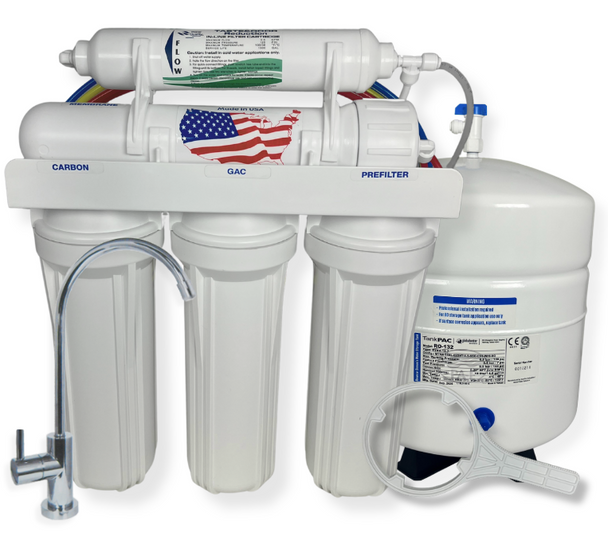
RO Zoi Alpha Pure — 5-Stage Water Purification RO System
Five-stage reverse osmosis for PFAS, lead, nitrate, arsenic, uranium, trihalomethanes, chlorine taste and over a thousand other contaminants. For a Virginia household on a flagged public system — or on a private well no rule covers — this is the layer that exists today rather than in 2029.

Filmtec 50 GPD RO Membrane — NSF Certified Replacement
Industry-leading rejection rates against dissolved minerals, lead, nitrate and PFAS, with a two-to-four year service life. Universal fit for virtually every under-sink RO system in a Virginia kitchen.

Air Injection Iron & Sulfur Filter
Iron and sulfur are the two most common well complaints in the Commonwealth, and both go in front of the softener, not behind it. Air injection oxidizes hydrogen sulfide, iron and manganese chemical-free at the point of entry.
Water Conditioners For Hard Water — Built for Virginia's Septic Country
Water conditioners alter how hardness minerals crystallize so they can't form scale — no salt, no regeneration, no brine, no discharge line. Ninety-two percent of the Commonwealth's million-plus private-well households are also on septic, and Virginia's onsite sewage rules, including a 100-foot drainfield-to-well setback, leave little appetite for adding a chloride load to a drainfield you're actively trying to protect. The honest trade-off: a conditioner protects equipment from scale but won't give soft-water lather and won't reduce hardness on a test. In genuinely hard Valley water, a softener performs better.
View All Conditioners & Whole House Filters →
Salt-Free Water Conditioner
No salt to buy, no brine tank, no regeneration cycle, no wastewater, no added sodium, and no discharge question to answer against VDH septic rules. The first thing to look at if you're among the 92% of Virginia well households on septic, or in a condo without a convenient drain line.
AFW City-Pro 48k — Water Conditioner for Hard Water + KDF Multi-Media
NSF-certified Purolite resin plus KDF multi-media in a single tank, handling hardness alongside heavy metals, bacteria and taste-and-odor. The pick for Northern Virginia and Roanoke-area homes at the harder end of public supply.

Whole House Carbon System
The cheapest fix for the most common complaint on any Virginia surface-water system. TTHM and HAA5 run highest at the ends of the network — a point-of-entry carbon system takes both out before they reach any fixture in the house.
Why Virginia Homeowners Choose AFWFilters
Since 1998, we've matched thousands of homeowners to the right system for their specific water — not a generic recommendation.
We'll Tell You If Your Water Isn't That Hard
Virginia Cooperative Extension puts the treatment threshold at 7 gpg, and plenty of Virginia addresses sit under it. Third-party sites publish flat per-city hardness numbers we couldn't verify against a single primary utility source — Richmond alone gets quoted anywhere from 4.1 to 7.2 gpg. We size off published utility figures and your lab report, and if a salt-free conditioner is the right call, we'll say so even though it isn't our most expensive product.
Send Us Your Extension Test Results
Virginia has one of the best university well-testing programs in the country. The Virginia Household Water Quality Program runs clinics through county Extension offices covering 14 to 28 parameters for around $70. Email us the lab report and we'll size to it — and tell you where you need less than you were quoted.
Real Water Treatment Experts on the Phone
Call 785-661-2241, Monday to Friday, 8am–4pm CT and reach someone who can read a Fairfax Water report or an Extension lab panel and build a spec from it. No chatbot, no script, no in-home sales appointment. Family-owned in Pfeifer, Kansas since 1998.
Parts Stay Available, and 120 Days to Change Your Mind
Fleck control valves, rebuild kits and cartridges on the shelf years later. Every water softener system, water conditioner and water purification RO system we ship to Virginia carries a 120-day money-back guarantee — we'd rather size it right the first time than process a return.
Verified Reviews from Virginia Homeowners
The system we purchased from AFW was the lowest price and still the best softener we could find. The shipping was quick and arrived in great condition. Installation was simple and complete in only a couple of hours. Highly recommend AFW systems.
I have purchased two water softeners from AFW. Mariah in support was extremely helpful in choosing the right products. Once I purchased, she was available to answer all of my installation and programming questions. She provided access to documentation and videos to make the job easier. I would definitely recommend AFW.
Very well packaged order. The detailed instructions are very thorough and helpful. Everything works as it should. One item was in back order and it was communicated well. The bracket they use for big blue is well made and strict compared to ones I have had in the past.
Virginia Water Filtration FAQ
Is Virginia's water hard or soft?
How hard is Northern Virginia's water?
At what point is a water softener system actually worth it?
My well water stains everything orange and smells like rotten eggs. What do I need?
My water is soft but it's eating my pipes. Why?
Should I worry about PFAS in Virginia?
I'm on a well and septic. Can I install a water softener system?
How do I get my Virginia well water tested?
Virginia's Average Hardness Tells You Nothing. Your Test Does.
Whether you're in Loudoun on Fairfax Water at the top of a 5-to-10-grain range, in Harrisonburg on carbonate aquifer water that nobody publishes a number for, in Blacksburg with soft water quietly dissolving your copper, or out on a Piedmont well fighting iron and sulfur — send us your Extension lab report or your utility's water quality report and we'll size the right system. Including when the answer is less than you were quoted.
Nationwide Coverage
Helping Customers Across the Country
Find the right water filtration system for your city. AFW Filters proudly serves homes and businesses in these areas.