
Faucets
RO System Faucets: Air Gap and Non-Air Gap Reverse Osmosis Faucets
Your RO system faucet is the one part of your water treatment you touch every day. It's also where problems show up first: a slow drip, a stiff handle, or a finish that doesn't match the rest of the kitchen.
Every faucet here is built around a ceramic disc valve and a standard 1/4-inch connection, so it works as the final point of most reverse osmosis faucet filter setups. Your first decision is air gap or non-air gap. After that, it comes down to style.
Air Gap or Non-Air Gap: Make This Choice First
Air gap and non-air gap faucets deliver the same filtered water. The difference is under the sink: how the RO system's drain line is plumbed, and how large a hole the faucet needs in your countertop or sink deck. Get this right, and the install is straightforward. Get it wrong, and you're re-drilling or re-routing tubing.
What a Reverse Osmosis Air Gap Does
While it makes filtered water, an RO system sends a small stream of reject water to the drain. In an air gap faucet, that drain water travels up into the faucet body, falls across an open gap, then flows down a separate line to the sink drain.
Because the line is physically broken, water from a clogged or backed-up drain has no path back into the RO system. That separation is the whole point of an air gap for reverse osmosis: backflow protection with no moving parts.
When Plumbing Code Calls for an Air Gap for an RO System
Some local plumbing codes require an air gap for an RO system. Others accept a non-air gap faucet with a drain saddle. Requirements vary by city and state, so check with your local plumbing inspector before you drill.
If an air gap is required, the choice is made for you. If it isn't, this comparison covers the practical differences.
| Air gap faucet | Non-air gap faucet | |
|---|---|---|
| Mounting hole | 7/8 inch | 7/16 to 1/2 inch (Euro Style) |
| Connections | 1/4-inch filtered water inlet plus 2 drain barbs | 1/4-inch filtered water inlet only |
| Drain line | Runs through the faucet, then to the sink drain | Connects to a drain saddle on the sink drain pipe |
| Best fit | Homes where code requires an air gap, or owners who want built-in backflow protection | Retrofits, stone countertops, and the simplest install |
Air Gap RO Faucets
An air gap RO faucet puts backflow protection where you can see it, at the countertop instead of under the sink. The PURETECK Euro Style Airgap Long Reach RO Faucet pairs that protection with a clean Euro profile, a quarter-turn handle, and a long reach spout.
It comes in six finishes: chrome, brushed nickel, brushed stainless steel, oil-rubbed bronze, black, and white. It's the natural RO faucet with an air gap for homes where code requires one, and a smart upgrade anywhere you want an air gap faucet for a reverse osmosis system.
Reverse Osmosis Water Faucet With Air Gap: How It Connects
Each air gap faucet has a 1/4-inch compression inlet for the filtered water line. It also has the 2 extra barbs an air gap install needs: one carries drain water up from the RO system, and one sends it down to the sink drain.
With those drain connections built in, a reverse osmosis water faucet with an air gap does two jobs in one fitting. It dispenses your drinking water and protects the system from drain backflow.
Planning the 7/8-Inch Mounting Hole
Air gap faucets need a 7/8-inch mounting hole, larger than a standard RO faucet. Check any existing sprayer or soap dispenser hole first, since it may save you drilling.
You may hear a soft gurgle at the faucet while the system sends water to the drain. That's the air gap doing its job. If the gurgle turns loud and constant, check the drain line for a kink or clog.
Non-Air Gap RO Faucets
A non-air gap RO faucet has one job: delivering filtered water. The drain line connects to a drain saddle on the sink drain pipe, so only a single 1/4-inch line runs up to the faucet.
That makes a non-air-gap faucet the simplest install and the easiest retrofit wherever code allows it. Each non-air-gap reverse osmosis faucet here uses a 1/4-inch compression or quick connect inlet. With four styles and the widest range of finishes, this is also the largest collection on the page.
Non-Air-Gap Drinking Water Faucet Styles
Every non-air-gap drinking water faucet below fits the same single-line install, so the choice comes down to looks and how you use it.
- Euro Style Long Reach: The PURETECK Euro Style Non-Airgap Long Reach RO Faucet has a quarter-turn handle and an angled spout for filling larger containers. It comes in seven finishes, including almond.
- Euro Style Candy Cane: The PURETECK Euro Style Non-Airgap Candy Cane RO Faucet has a tall, curved spout in chrome, brushed nickel, or oil-rubbed bronze.
- Designer Style: A touch-flow faucet, available as the Designer Style Non-Airgap Long Reach RO Faucet - Chrome or the PURETECK Designer Style Non-Airgap Long Reach RO Faucet in several contemporary finishes.
- Puroflo: The Puroflo Non-Airgap RO Faucet - Chrome has a turn-style knob and a 1/4-inch quick connect fitting for a fast hookup to a standard RO faucet line.
Why a 7/16 to 1/2-Inch Hole Makes Installs Easier
The PURETECK Euro Style non-air gap faucets mount in a 7/16 to 1/2-inch hole, much smaller than the 7/8-inch hole an air gap faucet needs. That means less drilling and less risk on quartz or granite countertops. There's also a better chance an existing hole in your sink deck already fits.
Finishes That Match Your Kitchen Faucet
Your RO faucet sits right beside your main tap, so it should look like it belongs there. When you set up a kitchen faucet with reverse osmosis drinking water beside it, matching finishes make the pair read as one design instead of an add-on.
Seven Finishes for Every Kitchen
Chrome, brushed nickel, brushed stainless steel, oil-rubbed bronze, black, and white are available in both air gap and non-air gap models. Almond is available in the non-air gap Euro Style faucet. Finishes are shown as accurately as possible, though screens can shift colors slightly.
Long Reach or Candy Cane Spout
A long reach spout angles water out over the sink so you can fill larger containers. A candy cane spout rises higher and curves over, giving extra room for tall bottles, pitchers, and coffee maker reservoirs.
Built for Daily Use
A drinking water faucet gets turned on and off more often than almost anything else in the kitchen. The parts inside decide whether it still runs smoothly years from now or starts dripping by next season.
Ceramic Disc Valves
A ceramic disc valve controls flow with two hard, polished discs instead of a rubber washer that wears and compresses over time. The result is smooth, long-lasting handle movement and dependable shut-off.
Quarter-Turn Handle
PURETECK Euro Style faucets use a finish-matched quarter-turn handle that goes from off to full flow in one short motion. It's easy to work one-handed while you hold a glass or pitcher.
Repairable, Not Disposable
If a PureT Euro style faucet starts to leak after years of use, the PureT Faucet Ceramic Disc Repair replaces the worn ceramic disc. You keep the faucet and the finish you chose, and stop the leak at its source.
Will It Fit My RO System?
Every faucet here connects to standard 1/4-inch tubing, the size used on most RO systems and under-sink filters. That makes each one a direct replacement when an old faucet wears out, and a simple upgrade when you want a better finish or an air gap.
Starting from scratch? Pair your faucet with one of our drinking water RO systems and the connections line up from day one.
Slow Flow Isn't Always the Faucet
If your filtered water slows to a trickle, look upstream before replacing a working faucet. Spent prefilters, an aging membrane, or low storage tank pressure restrict flow long before a ceramic disc valve does.
Check when your filters were last changed. Fresh filters from our replacement RO filter kits often restore flow without touching the faucet.
-

Designer Style Non-Airgap Long Reach RO Faucet - Chrome
$25.00Standard touch-flow faucet in the standard chrome finish. This non-airgap faucet can be used as a replacement with most reverse osmosis and water filtration systems that utilize similar faucets. ...FCT-DS-CHR$25.00 -

PureT Faucet Ceramic Disc Repair
$12.95Repair disc for PureT euro style faucets Product Features Stop LeaksReplaces the ceramic disc that can allow leaks over time For PureT Euro FaucetsFits PureT euro styleFCT-repair-disc$12.95 -

PURETECK Euro Style Non-Airgap Long Reach RO Faucet - Brushed Nickel
$54.00Brushed Nickel FinishNon Air GapQuarter-Turn HandleCeramic Disc1/4-inch Compression Water InletLong Reach SpoutRequires 7/16-1/2 inch mounting holeFCT-ES-BN$54.00 -

PURETECK Euro Style Airgap Long Reach RO Faucet - Oil Rubbed Bronze
$60.00Euro style faucet with quarter-turn water control in an oil rubbed bronze finish. This airgap faucet can be used as a replacement or upgrade with most reverse osmosis and water filtration systems...FCT-ESAG-ORB$60.00 -

PURETECK Euro Style Non-Airgap Long Reach RO Faucet - Brushed Stainless Steel
$54.00Brushed Stainless Steel FinishNon Air GapQuarter-Turn HandleCeramic Disc1/4-inch Compression Water InletLong Reach SpoutRequires 7/16-1/2 inch mounting holeFCT-ES-BSS$54.00 -

Puroflo Non-Airgap RO Faucet - Chrome
$34.00Basic chrome finish RO faucet with turn style knob. Includes 1/4" quick connect fitting for simple connection to standard RO faucet line.FCT-ESPG-CHR$34.00 -

PURETECK Euro Style Non-Airgap Long Reach RO Faucet - Oil Rubbed Bronze
$54.00Oil Rubbed Bronze FinishNon Air GapQuarter-Turn HandleCeramic Disc1/4-inch Compression Water InletLong Reach SpoutRequires 7/16-1/2 inch mounting holeFCT-ES-ORB$54.00 -
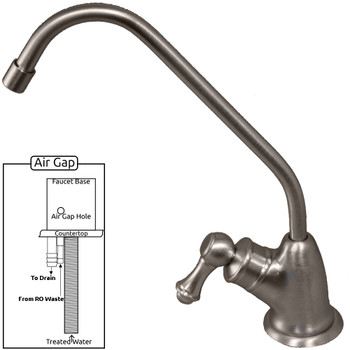
PURETECK Euro Style Airgap Long Reach RO Faucet - Brushed Stainless Steel
$60.00Brushed Stainless Steel FinishAir GapQuarter-Turn HandleCeramic Disc1/4-inch Compression Water InletLong Reach SpoutRequires 7/8 inch mounting holeFCT-ESAG-BSS$60.00 -

PURETECK Euro Style Airgap Long Reach RO Faucet - Brushed Nickel
$60.00Brushed Nickel FinishAir GapQuarter-Turn HandleCeramic Disc1/4-inch Compression Water InletLong Reach SpoutRequires 7/8 inch mounting holeFCT-ESAG-BN$60.00 -

PURETECK Euro Style Airgap Long Reach RO Faucet - Chrome
$60.00Chrome FinishAir GapQuarter-Turn HandleCeramic Disc1/4-inch Compression Water InletLong Reach SpoutRequires 7/8 inch mounting holeFCT-ESAG-CHR$60.00 -

PURETECK Euro Style Non-Airgap Long Reach RO Faucet - Chrome
$54.00Chrome FinishNon Air GapQuarter-Turn HandleCeramic Disc1/4-inch Compression Water InletLong Reach SpoutRequires 7/16-1/2 inch mounting holeFCT-ES-CHR$54.00 -

PURETECK Euro Style Non-Airgap Long Reach RO Faucet - Black
$54.00Black FinishNon Air GapQuarter-Turn HandleCeramic Disc1/4-inch Compression Water InletLong Reach SpoutRequires 7/16-1/2 inch mounting holeFCT-ES-BLK$54.00 -

PURETECK Designer Style Non-Airgap Long Reach RO Faucet - Contemporary Finishes
$39.00Standard touch-flow faucet available in several contemporary finishes to match your current decor. This non-airgap faucet can be used as a replacement or upgrade with most reverse osmosis sand water...FCT-DS$39.00 -

PURETECK Euro Style Non-Airgap Candy Cane RO Faucet - Brushed Nickel
$65.00Brushed Nickel FinishNon Air GapQuarter-Turn HandleCeramic Disc1/4-inch Compression Water InletCandy Cane SpoutRequires 7/16-1/2 inch mounting holeFCT-F05-BN$65.00 -

PURETECK Euro Style Non-Airgap Long Reach RO Faucet - White
$54.00White FinishNon Air GapQuarter-Turn HandleCermaic Disc1/4-inch Compression Water InletLong Reach SpoutRequires 7/16-1/2 inch mounting holeFCT-ES-WHT$54.00