
Water Filters Tampa
Tampa's Water Isn't Just Hard. It Moves — from 8 Grains to 17.
The Tampa Water Department publishes its own average: 185 mg/L, or 10.8 grains per gallon, treated at the David L. Tippin facility on the Hillsborough River. The utility also publishes the range, and the range is the number that matters — 140 to 300 mg/L, 8 to 17 grains per gallon, lower in the wet season and higher in the dry. That is not a rounding error. It is the difference between a softener that works and a softener that runs out of capacity in March. We size to your peak, not your average, and we ship direct to Hillsborough County with no dealer markup and no in-home sales appointment.
Contaminant Snapshot
Tampa stopped adding fluoride in 2025 — confirmed by the utility. Under SB 700, the 2025 Florida Farm Bill signed May 20, 2025, local governments were barred from adding water-quality additives as of July 1, 2025. Tampa took its final fluoride delivery on April 4, 2025 and ran out its remaining supply by the end of June. The City's 2024 water quality report confirms fluoride is no longer added. Naturally occurring fluoride remains — Tampa detected 0.62 ppm before the change. What this means for you: if fluoride reduction was driving your purchase, that reason is gone — 0.62 ppm is nowhere near the level that justifies a dedicated fluoride filter. Redirect that budget toward hardness and chloramine, which is where Tampa's actual money is. Call 785-661-2241 before you buy the wrong thing.
Where your softener discharges matters in Hillsborough County. Florida has no standalone water-softener brine statute — discharge falls under the state's general water pollution framework in Chapter 403, Florida Statutes. If you're on city sewer in Tampa, confirm acceptance with the utility. If you're on septic — common in Lutz, Odessa, Thonotosassa and rural Plant City — check locally before plumbing brine to a drainfield.
hardness (10.8 GPG)
seasonal range
systems outside the city
on every system
Six Reasons Tampa Tap Water Needs Treatment
All figures below are from the Tampa Water Department 2024 Water Quality Report (published 2025; PWS ID #6290327), covering January 1 to December 31, 2024.
10.8 Grains Is Over the Very-Hard Line
Dry-Season Spikes Break Undersized Systems
Chloramine Is Not Chlorine, and It Doesn't Gas Off
Disinfection Byproducts Rise at the End of the Line
Old Tampa Plumbing, Not Old Tampa Mains
County Well Water Is a Different Problem Entirely
How Hard Is Your Tampa Area's Water?
The most useful thing to know about Tampa hardness is which utility you're on. The City of Tampa treats Hillsborough River water at the Tippin plant and publishes one number for the whole system. Step outside the city limits and it changes: Hillsborough County Water Resources runs eleven separate community water systems, each with a heavier groundwater component. Temple Terrace and Plant City run their own municipal utilities, and thousands of homes in Lutz, Odessa, Keystone and rural Plant City draw straight from the Floridan Aquifer.
City of Tampa — Core
Downtown, Hyde Park, Davis Islands, Westshore, South Tampa, Bayshore
City of Tampa — Older Stock
Seminole Heights, Tampa Heights, Ybor City, West Tampa, Sulphur Springs
City of Tampa — Northern Edge
New Tampa, Tampa Palms, Hunter's Green, Carrollwood Village
Hillsborough County Water Resources
Brandon, Riverview, Apollo Beach, Sun City Center, Ruskin, Gibsonton
Independent Municipal
Temple Terrace, Plant City — not covered by Tampa's report
Private Floridan Wells
Lutz, Odessa, Keystone, Thonotosassa, Dover, Seffner, rural Plant City
Note: Legend — 0–3.5 GPG soft · 3.5–7 GPG moderate · 7–10.5 GPG hard · 10.5+ GPG very hard. Tampa's 10.8 GPG average sits just over the very-hard line, and its published dry-season peak of 17 GPG is deep into it. Sizing to the average is the single most common Tampa mistake we correct on the phone.
Tampa Water Quality by Area & Recommended Solution
| Neighborhood / Area | Utility & Source | Hardness | Key Contaminants | Severity | Recommended Bundle |
|---|---|---|---|---|---|
| Downtown / Hyde Park / Davis Islands | City of Tampa — Tippin plant | 10.8 avg; 17 peak | Hardness, chloramine, DBPs | HIGH | 48k Softener + Whole House Carbon |
| Westshore / South Tampa / Bayshore | City of Tampa — Tippin plant | 10.8 avg; 17 peak | Hardness, chloramine, bromate | HIGH | 48k Softener + RO System |
| Seminole Heights / Tampa Heights / Ybor | City of Tampa — pre-1986 stock | 10.8 avg; 17 peak | Hardness, lead at fixtures, DBPs | HIGH | 48k Softener + RO System |
| West Tampa / Sulphur Springs | City of Tampa — Tippin plant | 10.8 avg; 17 peak | Hardness, chloramine, lead | HIGH | 48k Softener + RO System |
| New Tampa / Tampa Palms / Hunter's Green | City / county distribution edge | 10.8 avg; 17 peak | Hardness, TTHM & HAA5 at line ends | HIGH | 64k Softener + Whole House Carbon |
| Carrollwood / Northdale | City + county service areas | Verify by address | Hardness, chloramine | HIGH | 48k Softener + Carbon Filter |
| Brandon / Riverview | Hillsborough County Water Resources | Request system report | Hardness, chloramine, groundwater minerals | HIGH | 48–64k Softener + RO System |
| Apollo Beach / Ruskin / Sun City Center | Hillsborough County Water Resources | Request system report | Hardness, sulfur, sodium | HIGH | 48–64k Softener + Sulfur Filter |
| Temple Terrace | Independent municipal utility | Request CCR | Hardness, DBPs | MODERATE | Softener sized to utility's number + RO |
| Plant City (municipal) | Independent municipal utility | Request CCR | Hardness, iron | MODERATE | Softener sized to CCR + Iron Filter |
| Lutz / Odessa / Keystone | Private Floridan Aquifer wells | Test req'd; commonly 15+ GPG | Iron, manganese, H₂S, hardness | SEVERE | Air Injection Filter + 64k Softener + UV |
| Thonotosassa / Dover / Seffner / rural Plant City | Private wells + septic | Test required | Iron, sulfur, hardness; brine to drainfield | SEVERE | Air Injection + 64k Softener, or Salt-Free Conditioner on septic |
Note: Source: Tampa Water Department 2024 Water Quality Report (PWS ID #6290327) and Hillsborough County Water Resources system reports, 2025.
Water Softener Systems for Tampa Homes
At Tampa's published 10.8 grains per gallon, a water softener system is not a comfort purchase — it is the workhorse, and ion exchange is the only thing that physically removes the calcium and magnesium rather than managing how they behave. The question is not whether, it is how big. Take peak hardness, not average: a four-person Tampa household using about 300 gallons a day at 17 GPG loads roughly 5,100 grains daily. A 32,000-grain unit regenerates every four to five days at that load; a 48,000-grain unit gives you real headroom when the dry season arrives.
View all softeners →
48k Water Softener System — Fleck 5600SXT, 10% Crosslink Resin
The honest fit for a typical City of Tampa household of 2–4 people, sized to the 17-grain dry-season peak rather than the 10.8-grain average. Demand-metered regeneration keeps salt and water use down under Tampa Bay water conservation rules.

64k Water Softener System — Fleck 5600SXT, 10% Crosslink Resin
For 3–5 person households, New Tampa and other distribution-edge addresses, and private Floridan Aquifer wells in Lutz, Odessa and Thonotosassa where hardness runs past 15 grains. Iron-capable, and the right anchor for a well-water treatment train.

40k Water Softener System — Fleck 5600SXT
For one- and two-person households and downtown condos where the load is genuinely lower. Oversizing a softener wastes salt and money — if 40k is the right capacity for your usage, we will say so rather than sell you up.
Salt-Based Water Softener System vs. Salt-Free Water Conditioner — Which Fits a Tampa Home?
Salt-Based Water Softener System
- Physically removes calcium and magnesium by ion exchange
- Eliminates scale rather than just preventing adhesion
- Clear answer at Tampa's 10.8 GPG average and 17 GPG peak
- Demand-metered valves are salt- and water-efficient
- Gives the slick soft-water feel and drops hardness on a test
- Adds sodium; Tampa's baseline is already 46 mg/L
- Requires salt, a brine tank, and a confirmed discharge path
Salt-Free Water Conditioner for Hard Water
- No salt, no brine, no discharge, no sodium added
- Conditions hardness so minerals don't bond to surfaces
- Right where discharge is the constraint — septic homes and condos with no drain access
- Nothing to refill, no regeneration cycle, no wastewater
- Does not remove calcium and magnesium or lower hardness on a test
- Underdelivers against Tampa's 17-grain peaks where sewer/drain access exists
Water Purification RO Systems for Tampa Drinking Water
A softener fixes hardness and nothing else. It does not touch chloramine taste, the HAA5 and TTHM in Tampa's distribution system, the bromate from the ozone step, the PFAS detected in 2024 UCMR5 sampling, or the lead that one sampled Tampa home returned at 14.6 ppb. A water purification RO system handles all of them at the tap — and it also strips out the sodium your softener just added. Pair them correctly: softener or conditioner at the point of entry, RO under the kitchen sink, catalytic carbon wherever chloramine odor is the actual complaint.
View all RO systems →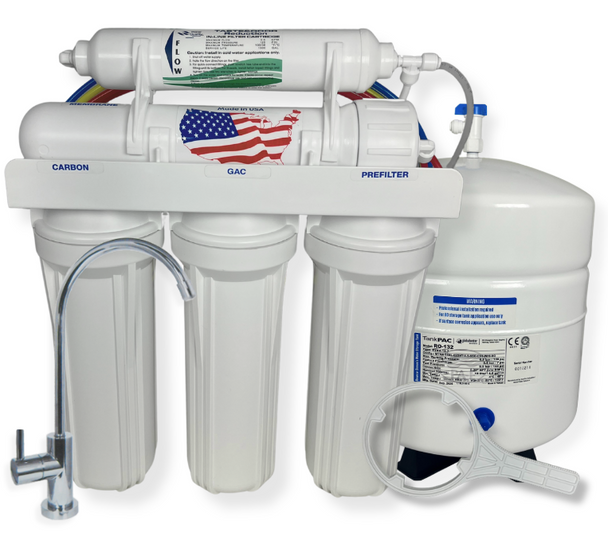
RO Zoi Alpha Pure — 5-Stage Water Purification RO System
Five-stage reverse osmosis for lead, trihalomethanes, haloacetic acids, bromate, PFAS, chloramine taste and over a thousand other contaminants. In Tampa, where hardness is handled at the point of entry, this is what covers everything the softener cannot.

Filmtec 50 GPD RO Membrane — NSF Certified Replacement
Industry-leading rejection rates against dissolved minerals, lead and disinfection byproducts, with a two-to-four year service life. Universal fit for virtually every under-sink RO system in a Tampa kitchen.

Air Injection Iron & Sulfur Filter
The City of Tampa runs an ozone step that strips taste and odor before water leaves the plant. On a private Floridan Aquifer well in Lutz, Odessa, Keystone or Thonotosassa, nobody is doing that for you. Air injection oxidizes hydrogen sulfide, iron and manganese chemical-free at the point of entry — and it goes in ahead of the softener, not after it.
Water Conditioners for Hard Water — The No-Discharge Option in Tampa
We'll be straight about this one. Tampa is not the city where we steer most customers toward conditioning — at 10.8 grains average and 17 at peak, ion exchange simply performs better. Water conditioners for hard water earn their place in Tampa on a different axis: discharge. If you're on septic in Lutz, Odessa or rural Plant City, or in a downtown condo with no drain access, a conditioner protects your pipes, fixtures and water heater from scale with no salt, no brine, no regeneration cycle and no discharge line at all. That's a real answer to a real constraint. It is not the same product as a softener, and we won't pretend it is.
View all conditioners & whole-house filters →
Salt-Free Water Conditioner
No salt to buy, no brine tank to fill, no regeneration cycle, no wastewater, no added sodium, and no Chapter 403 discharge question to answer. The option to look at first if you're on septic, in a condo or townhome, or anywhere without a convenient drain line.
AFW City-Pro 48k — Water Conditioner for Hard Water + KDF Multi-Media
NSF-certified Purolite resin plus KDF multi-media in a single tank, handling Tampa's hardness alongside heavy metals, bacteria and taste-and-odor. The pick when you want the chloramine complaint and the scale complaint solved by one unit at the point of entry.

Whole House Catalytic Carbon System
The correct fix for Tampa's most common water complaint. Chloramine is more stable than free chlorine and standard carbon underperforms against it — catalytic carbon is the media that works, and at the point of entry it treats every fixture in the house, not just the kitchen tap.
Why Tampa Homeowners Choose AFWFilters
Since 1998, we've matched thousands of homeowners to the right system for their specific water — not a generic recommendation.
We Size to Your Dry-Season Peak, Not Your Annual Average
The Tampa Water Department publishes 185 mg/L as the average and 140–300 mg/L as the range. Competitor pages quote Tampa at a single flat number anywhere from 7 to 20.5 grains, and none of them explain the swing. We size off the utility's published peak, because a system that fails in March is not a system.
We Ask Which Utility Serves You First
The City of Tampa is one system. Hillsborough County Water Resources runs eleven more, each with its own annual report. Temple Terrace and Plant City run their own. Thousands of homes in Lutz, Odessa and Thonotosassa run no utility at all. Getting this question wrong is the most common way a Tampa-area homeowner buys the wrong system.
Real Water Treatment Experts on the Phone
Call 785-661-2241, Monday to Friday, 8am–4pm CT and reach someone who can read a Tampa CCR or a Hillsborough County system report and build a spec from it. Not a chatbot, not a script, not a lead handoff to a commissioned local installer. Family-owned in Pfeifer, Kansas since 1998.
120-Day Money-Back Guarantee
Every water softener system, water conditioner for hard water, and water purification RO system we ship to Tampa carries a 120-day guarantee. We'd rather size it right the first time than process a return — and if the honest answer is a smaller unit than you were quoted, that's the answer you'll get.
Verified Reviews from Tampa Homeowners
The system we purchased from AFW was the lowest price and still the best softener we could find. The shipping was quick and arrived in great condition. Installation was simple and complete in only a couple of hours. Highly recommend AFW systems.
I have purchased two water softeners from AFW. Mariah in support was extremely helpful in choosing the right products. Once I purchased, she was available to answer all of my installation and programming questions. She provided access to documentation and videos to make the job easier. I would definitely recommend AFW.
Very well packaged order. The detailed instructions are very thorough and helpful. Everything works as it should. One item was in back order and it was communicated well. The bracket they use for big blue is well made and strict compared to ones I have had in the past.
Tampa Water Filter FAQ
How hard is Tampa tap water, really?
Do I actually need a water softener system in Tampa?
What size water softener do I need for a Tampa home?
Why does my Tampa water smell or taste chemical, especially in summer?
Is there lead in Tampa's water?
Does Tampa still add fluoride to the water?
I'm on a septic system — can I still install a water softener system?
My well water stains fixtures orange and smells like rotten eggs. Will a softener fix it?
Tell Us Your Address. We'll Tell You Which Utility — and Which System.
Whether you're in South Tampa on city water wondering why your softener quit in March, in Riverview on one of eleven county systems, in Temple Terrace on a municipal utility nobody quotes numbers for, or out in Lutz on a private Floridan Aquifer well fighting sulfur and iron — we'll size the water softener system, water conditioner for hard water, or water purification RO system to your actual utility and your actual peak. And if the answer is a smaller system than you expected, we'll say that too.
Nationwide Coverage
Helping Customers Across the Country
Find the right water filtration system for your city. AFW Filters proudly serves homes and businesses in these areas.