
Clack
Clack WS1 Water Softeners and Whole-House Filters
Every automated water treatment system in a house comes down to one component thinking: the control valve. It decides when the system runs, how long it backwashes, when it draws brine, and when it goes back to service. Clack's WS1 platform is one of the most widely installed residential control valves in North America, and it sits on top of softeners and filter tanks in millions of homes.
What a Clack Control Valve Actually Does
The WS1 is a residential control valve. It mounts on the top of a mineral tank, connects to your inlet and outlet plumbing, runs a line to drain, and, on a softener, connects to a brine tank as well. From there, it manages the treatment cycle without you touching anything.
Depending on the configuration and how it has been programmed, that cycle can include:
- Service. Normal operation, water passing through the media on its way to the house.
- Backwash. Reversing flow to lift and rinse the media bed, flushing trapped material to drain.
- Brine draw. On a softener only - pulling salt solution from the brine tank through the resin to recharge it.
- Rinse. Clearing the bed before the valve returns to service.
- Metered or timed initiation. Some configurations count gallons and regenerate based on actual use; others run on a clock.
Clack WS1 Softener vs. Clack WS1 Filter
The valve does not clean your water. The media in the tank does. The valve just runs the cycle.
| Feature | Clack WS1 Softener | Clack WS1 Filter |
|---|---|---|
| Main function | Reduces calcium and magnesium hardness | Treats a specific contaminant through the filter media |
| Media in tank | Ion-exchange resin | Carbon, oxidizing, specialty, or pH media |
| Brine tank | Usually required | Usually not required, depending on media |
| Regeneration | Uses salt and water | Generally water backwash only |
| Typical application | Scale and hard-water problems | Iron, sulfur, chlorine, odor, sediment, pH |
So a "Clack water filter" and a "Clack water softener system" can share the same valve family and still solve completely different problems.
Clack Water Softener Systems: What They Address
A softener works by ion exchange. Hard water passes through a bed of resin beads; the calcium and magnesium swap places with sodium held on the resin; softened water carries on to the house. When the resin fills up, the valve regenerates it with brine, and the cycle starts again.
The symptoms that send people looking for a softener are familiar: white scale crusting on fixtures and kettles, spotty glassware out of the dishwasher, soap that will not lather, a film on the shower door, skin that feels tight after washing, and - the expensive one - scale building inside the water heater and shortening its life.
Clack WS1 Whole House Filters
A whole-house filter installs at the point where the main line enters the building, so everything downstream gets treated water - showers, sinks, laundry, the water heater, appliances, and any drinking water system further along the line.
What it treats depends entirely on what you put in the tank:
- Carbon media for chlorine, taste, and odor.
- Catalytic carbon for chloramine and tougher chemical loads, including hydrogen sulfide.
- Oxidizing media such as Birm, Filox, or greensand for iron and sulfur on well water.
- Sediment media for turbidity and particulates.
- Calcite and neutralizing media for acidic water.
Test your water before you buy media. A carbon tank will not fix iron staining, and an iron filter will not fix low pH. Matching media to a confirmed problem is the difference between a system that works and an expensive tank of the wrong gravel. Start with a water test kit.
Why a Clack Valve Is Worth Repairing
This is why you should repair your clack valve:
Automatic Operation
Once programmed, the valve handles its own cycles. No manual regeneration, no scheduling, nothing to remember.
Serviceable Design
This is the real argument. Almost every wear part inside a WS1 is available individually, which means a failing valve is usually a $15 to $60 repair rather than a full system replacement. Commonly replaced items include the spacer stack assembly, downflow and brine pistons, injector assemblies, meter assemblies, and the universal repair wrench.
Long-Term Support
We stock parts for valves that have been in service for years, including components with superseded part numbers. If you are unsure whether a newer part supersedes what you have, our support team can check.
Choosing and Fitting a System
Step 1: Test First
Check hardness, iron, manganese, hydrogen sulfide, pH, chlorine or chloramine, and sediment before deciding anything. Water test kits and TDS meters are inexpensive next to the cost of installing the wrong media.
Step 2: Match Treatment to Problem
Softening, carbon filtration, iron and sulfur treatment, sediment filtration, and pH correction are different jobs requiring different media. A system can combine them, but each stage has to earn its place.
Step 3: Confirm Plumbing and Power
Check inlet and outlet size, bypass valve type, drain connection and available drain flow, brine line connection for softeners, power supply for digital configurations, and compatibility with your existing tank diameter and distributor tube.
Step 4: Verify the Part Number Before Ordering
If you are replacing a component rather than buying a system, compare the valve model, the part number printed on the old component, the approximate manufacturing date, connection size, tank diameter, downflow or upflow configuration, and control-board style. Injector colour and tank diameter in particular are easy to get wrong.
-
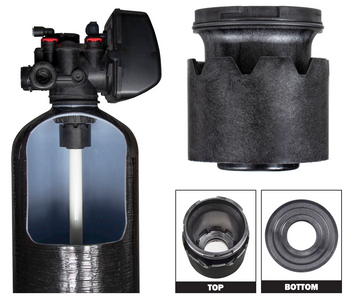
Air Blocker for air injection systems
$35.00The Air Blocker traps water in its chamber to block the head of air from re-entering the control valve body. This will help reduce the iron oxidation that occurs, in the control valve, on air over...CP-AIO-Blocker$35.00 -

Clack Part V3186-06 - Power Cord with 15V DC Transformer
$27.9915V DC Adapter V3186-06 fits Clack valves manufactured in 2017 or newer Is not compatible to systems that were manufactured before 2017 as those system were manufactured with an AC output. You will...CP-3186-06$27.99 -

Clack Universal Repair Wrench V3193-02 for WS1 and others
$24.99V3193-02 repair wrench can be used with all Clack Water Softeners and Filters Systems It can help remove and tighten pistons, and help install and loosen nuts and fittings on Clack valvesCP-CLWrench$24.99 -

Clack V300502 V3005-Clack WS1 Spacer Stack Assembly, Black and Grey
$39.99C3005 Clack WS1 Cage Spacer Stack Assembly. If the clack cage has one seal damaged, it will cause the water to continously leak out the drain Genuine part- partCP-V3005$39.99 -

Clack WS1 (WHITE) Injector Assembly V3010-1E
$14.00Clack WS1 White Injector Assembly for 10" DownFlow or 13" UpFlow Tank Diameter. Clack WS1 and 1.25 Injector Assembly with o rings.Refer to the chart below if you are not sure, noting that most...CP-CV30101E$14.00 -

Digital Catalytic Carbon 10 System with AFW filter valve
$986.00Standard-flow digital catalytic carbon system with Fleck 5600SXT for treatment of iron, hydrogen sulfide and a wide range of other tastes, chemicals, and odors. Product Features Complete SCCRB10-AFW-1-1$986.00 -

Digital Catalytic Carbon 15 System with AFW filter valve
$1,059.00Standard-flow digital catalytic carbon system with Fleck 5600SXT for treatment of iron, hydrogen sulfide and a wide range of other tastes, chemicals, and odors. Product Features Complete SCCRB15-AFW$1,059.00 -
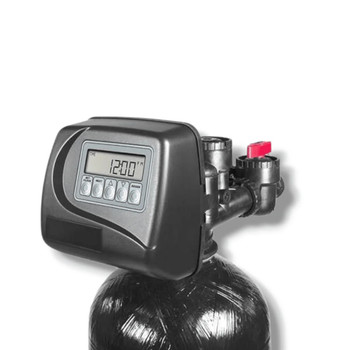
Digital Catalytic Carbon 20 System with AFW filter valve
$1,368.00Standard-flow digital catalytic carbon system with Fleck 5600SXT for treatment of iron, hydrogen sulfide and a wide range of other tastes, chemicals, and odors. Product Features Complete SCCRB20-AFW$1,368.00 -
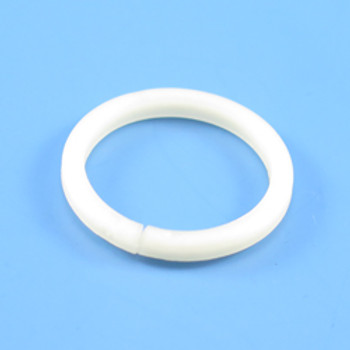
Split ring CV3150 for clack valves
$4.00Split ring used on many clack valves and bypass valves. Part CV 3150CP-3150$4.00 -

V3108 Circuit Board for Clack Water Softener 5 Button
$139.00Replacement circuit board for your WS1 valve Clack V3108 Replacement Circuit Board Interchangeable with older version Clack V31CP-3108$139.00 -

Weather Cover ALMOND 5 button WS1 Clack
$28.00V3175WC-A is the Almond Weather tight Cover for Front Cover Assembly of the Clack WS1,3, 4 and 5-Button Valves.Measurements of the cover are 7 1/2" x 4 1/4" x 6"WS1-Cover$28.00 -

WS1 Injector (RED) for 9" Downflow or 12" Upflow V3010-1D
$14.00Clack WS1 Red Injector Assembly for 9" DownFlow or 12" UpFlow Tank Diameter Clack WS1 and 1.25 Injector Assemblies with o-rings. Refer to the chart below if you are not sure, noting that most valves...CP-CV30101D$14.00 -

WS1 Interior Kit Bundle with Seal Pack, Brine Piston-OEM Clack Parts
$59.00Kit contains 3 Clack part #'s for the Clack WS1 Control Valve Contains Downflow Piston V3011 Contains Brine Regenerant Piston V3174CP-WS1-Rebuild$59.00 -

WS1 Meter Replacement Assembly Part V3003, CV3003-05
$109.00WS1 Meter Assembly Meter Assembly (includes Meter Plug, O-ring, Turbine, and cable) for Clack WS1 and WS1.25 Valve.This PN V3003 (newest part number V3003-05)CP-3003-05$109.00