
Water Filters Michigan
Michigan Water Changes from Great Lakes Supply to Hard Groundwater — Often Within the Same County.
Michigan water quality depends on your city, utility and source. Detroit receives treated Lake Huron water through the Great Lakes Water Authority, Grand Rapids receives Lake Michigan water, and Ann Arbor draws from the Huron River. Other Michigan communities rely on groundwater, which can contain higher levels of calcium, magnesium, iron, manganese, arsenic or nitrate. Ann Arbor's 2024 report recorded an average hardness of 135 mg/L, or 7.9 GPG, with results ranging from 90 to 216 mg/L. A water softener system can reduce scale caused by calcium and magnesium, a water purification RO system handles point-of-use drinking-water treatment, and water conditioners offer a salt-free scale-control option.
Contaminant Snapshot
water-system data
2024 average hardness
above EWG's guideline
money-back guarantee
Michigan Communities Are Addressing Chloride from Water Softeners
Michigan's environmental agencies identify chloride discharge as a water-quality concern. Salt-based water softeners send chloride-rich brine to a wastewater or septic system during regeneration — and Michigan communities aren't all handling it the same way.
EGLE Points Toward Efficient Softener Practices
Michigan EGLE guidance identifies alternative water-conditioning systems and efficient softener practices as ways to reduce salt discharged to wastewater treatment plants — not a mandate to abandon ion exchange altogether.
No Statewide Ban, But Local Rules Differ
Michigan does not have one statewide ban on residential salt-based water softeners. However, some townships and villages prohibit or limit softener discharge to sanitary sewers or septic systems, while others require high-efficiency, demand-initiated systems.
Check Your Township, HOA and Septic Rules First
Before installing a salt-based system, check your local wastewater authority, township, HOA and septic requirements. A demand-initiated softener or salt-free conditioner may be the better fit where brine discharge is restricted.
Not Sure What Applies to Your Address?
Call 785-661-2241 before you order — we can help you check whether your township restricts softener discharge and which system fits either way.
What this means for your filtration: most Michigan homes can still run a salt-based softener — the question is whether your local wastewater or septic rules call for demand-initiated regeneration or push you toward a salt-free conditioner instead. Confirm locally before you buy.
What Is Actually in Michigan Tap Water?
Detroit states that lead is not present in water leaving its treatment plants, but lead can enter drinking water through corrosion of lead service lines and household plumbing — the Detroit Water and Sewerage Department uses corrosion control, and homes sampled in 2024 were below the applicable EPA lead action level. EWG's Michigan database identifies PFOS and PFOA, arsenic, nitrate, TTHMs, HAA5 and other contaminants in the state's utility data — not the same as enforceable federal limits, so review your local Consumer Confidence Report alongside it.
| Contaminant or Concern | Severity | Typical Source |
|---|---|---|
| Hard Water Scale | CRITICAL | Calcium and magnesium in Great Lakes water, rivers, carbonate formations and groundwater. |
| Lead from Older Plumbing | CRITICAL | Lead service lines, solder, brass fixtures and household plumbing. |
| PFAS | HIGH | Historic industrial activity, firefighting foam and contaminated groundwater in affected areas. |
| TTHMs & HAA5 | HIGH | Disinfection reactions involving treatment chemicals and organic matter. |
| Arsenic & Nitrate | MODERATE | Naturally occurring minerals, agricultural activity and groundwater conditions. |
| Iron & Manganese | MODERATE | Groundwater and regional geology, especially in private-well systems. |
How Hard Is Your Michigan Water?
Michigan hardness changes according to the water source and treatment system. Detroit's Lake Huron supply is generally moderately hard, Ann Arbor's Huron River supply averaged 7.9 GPG in its 2024 report, and groundwater-dependent cities such as Flint and some suburban communities can be harder. Grand Rapids also publishes annual water-quality information, including hardness and mineral analysis.
| Sub-Area | Cities & Neighbourhoods | Typical Hardness |
|---|---|---|
| Detroit & Southeast Michigan | Downtown Detroit, Midtown, Corktown, Dearborn, Hamtramck | Approximately 6–8 GPG in available datasets; confirm by service area |
| Ann Arbor & Washtenaw County | Downtown Ann Arbor, Kerrytown, Burns Park, Pittsfield Township | Approximately 7.9 GPG average, with a reported 5.3–12.6 GPG range |
| Grand Rapids & West Michigan | Downtown Grand Rapids, Eastown, Heritage Hill, Wyoming, Kentwood | Approximately 9 GPG in available city-level datasets; confirm locally |
| Flint & Mid-Michigan | Downtown Flint, Grand Traverse District, Burton, Swartz Creek | Approximately 8–14 GPG in available datasets; confirm by system |
| Northern Michigan & Private-Well Communities | Traverse City, Alpena, Marquette, rural communities | Varies widely by groundwater source and local geology |
Legend: 0–3.5 GPG soft · 3.5–7 GPG moderately hard · 7–10.5 GPG hard · 10.5+ GPG very hard. Ann Arbor's official 2024 report is a useful example of local variation, recording hardness from 90 to 216 mg/L, or 5.3–12.6 GPG. Michigan customers should use their own utility's current figure rather than applying a statewide average.
Six Reasons Michigan Tap Water Needs Treatment
Hardness Varies Across Michigan
Lead Risk Comes from Plumbing
PFAS Conditions Are Location-Specific
TTHMs and HAA5 Can Form During Disinfection
Groundwater Can Contain Arsenic and Nitrate
Iron and Manganese Affect Well Water
Michigan Water Quality by Area & Recommended Solution
| Neighbourhood / Area | Source / Utility | Hardness | Key Concerns | Severity | Recommended Bundle |
|---|---|---|---|---|---|
| Downtown Detroit & Midtown | Great Lakes Water Authority — Lake Huron supply | Approximately 6–8 GPG | Hardness, lead from older plumbing, TTHMs | HIGH | 40k Softener + RO System |
| Dearborn & Hamtramck | Great Lakes regional supply | Approximately 6–8 GPG | Hardness, lead, chlorine taste, TTHMs | HIGH | 40k Softener + RO System |
| Ann Arbor & Pittsfield Township | Huron River and local treatment system | 5.3–12.6 GPG | Hardness, lead from older plumbing, TTHMs | HIGH | 48k Softener + RO System |
| Grand Rapids & Kentwood | Grand Rapids Water System — Lake Michigan supply | Approximately 9 GPG | Hardness, PFAS in regional data, TTHMs | HIGH | 48k Softener + RO System |
| Flint & Mid-Michigan | Flint and local municipal systems | Approximately 8–14 GPG | Lead, PFAS, hardness, TTHMs | SEVERE | 64k Softener + RO System |
| Rural Michigan & Private Wells | Groundwater and local aquifers | Test required | Hardness, iron, manganese, nitrate, arsenic and bacteria | SEVERE WHERE UNTREATED | 64k Softener + Water Test Kit |
Water Softener Systems for Michigan Homes
Michigan households with hard municipal water or groundwater can benefit from a properly sized water softener system. Because local wastewater rules may address chloride discharge, choose a demand-initiated system and program it according to actual household use.
View All Water Softeners →
40k Water Softener System — Fleck 5600, 10% Resin
A compact option for smaller Michigan homes or households with moderate hardness, including some Detroit and Ann Arbor service areas. Confirm hardness before selecting the capacity.

48k Water Softener System — Fleck 5600SXT, 10% Crosslink Resin
A practical fit for many two-to-four-person households with hard municipal water or moderately hard well water. Demand-metered regeneration can help avoid unnecessary cycles.

64k Water Softener System — High-Capacity Resin
Designed for larger Michigan households or groundwater areas where hardness, iron or manganese increases treatment demand. Test well water before selecting a combination system.
Salt-Based Water Softener System vs. Salt-Free Water Conditioner — Which Fits a Michigan Home?
Salt-Based Water Softener System
- Removes calcium and magnesium through ion exchange
- Stronger choice for very hard water and visible scale
- Protects plumbing and appliances throughout the home
- Requires salt, a brine tank and wastewater or septic discharge
- Demand-initiated models can reduce unnecessary discharge
- Must comply with local sewer, septic or township requirements
Salt-Free Water Conditioner
- Conditions hardness minerals to help reduce scale adhesion
- Useful for households that prioritise no salt and low maintenance
- Does not physically remove calcium and magnesium
- Does not require salt purchases or regeneration wastewater
- Avoids chloride-rich regeneration brine entirely
- May be a practical option where salt discharge is restricted
Water Purification RO Systems for Michigan Drinking Water
A softener addresses hardness. It does not provide broad treatment for lead, PFAS, nitrate, arsenic, radium, TTHMs or HAA5. A water purification RO system can provide treated water at the kitchen tap for drinking and cooking.
View All RO Systems →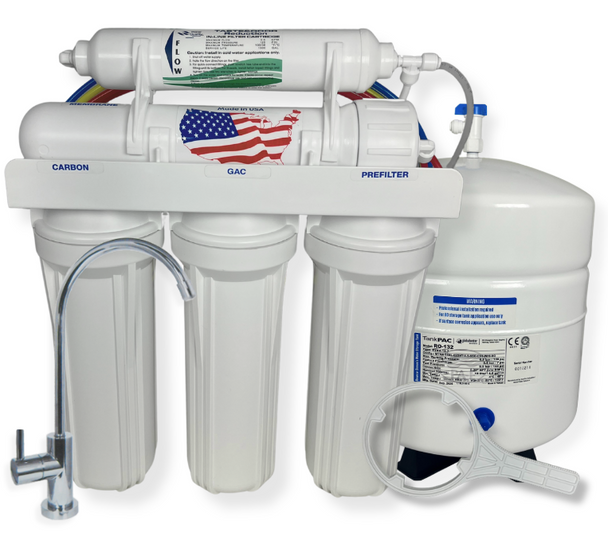
RO Zoi Alpha Pure — 5-Stage Water Purification RO System
A five-stage under-sink reverse-osmosis system for households seeking treated drinking and cooking water. May be relevant for homes with older plumbing or a confirmed dissolved contaminant, subject to the product's documented performance.

50 GPD NSF-Certified RO Membrane for Michigan Water Systems
A replacement membrane option for compatible standard 1812 under-sink RO systems. Confirm the existing system model, membrane size, fittings and replacement schedule before ordering.
6-Stage UV Zoi Gamma Pure Reverse Osmosis System
A six-stage RO system with UV treatment for households seeking an additional point-of-use treatment stage. May be useful for private-well households — well water should be tested first, as pretreatment may be required.
Water Conditioners For Hard Water in Michigan
Water conditioners for hard water can help Michigan households seeking scale control without salt, brine discharge or a regeneration cycle. They do not remove calcium and magnesium in the same way as an ion-exchange water softener system, so they may not be the right choice for very hard groundwater.
View All Conditioners & Whole-House Filters →
Scale Sentry Salt-Free Water Conditioner for Michigan Homes
A salt-free option for households that want scale-control support without purchasing salt or sending chloride-rich brine to the wastewater system. Uses specialised scale-prevention media and does not require salt regeneration.
AFW City-Pro 48k Water Conditioner for Hard Water and KDF Media
Combines Purolite resin with KDF media to address hardness alongside selected taste, odour and metals concerns. Confirm the current media configuration and product claims before purchase.

Whole-House Catalytic Carbon Filter for Michigan Taste and Odour
A catalytic carbon system can help reduce chlorine taste and selected disinfection byproducts before water reaches household fixtures. It doesn't replace a softener for hardness or an RO system for contaminants requiring point-of-use dissolved-solids reduction.
Why Michigan Homeowners Choose AFW Filters
Since 1998, we've matched thousands of homeowners to the right system for their specific water — not a generic recommendation.
We Start with Your Water Source
Detroit, Grand Rapids and Ann Arbor use different surface-water sources, while Flint, rural communities and many private wells depend on groundwater. We ask about your utility or well before recommending equipment.
We Account for Local Discharge Rules
Michigan communities may have different rules for softener brine, septic discharge and wastewater connections. We help you compare demand-initiated softeners with salt-free conditioning options before you buy.
We Separate Plumbing Protection from Drinking-Water Filtration
A water softener system is designed for calcium and magnesium. A water purification RO system is designed for point-of-use drinking-water treatment. Carbon systems address taste and odour. We match the product to the actual water concern.
120-Day Money-Back Guarantee
AFW Filters offers a 120-day money-back guarantee for eligible direct purchases, subject to the current guarantee terms. Call 785-661-2241 and review the conditions before ordering.
Verified Reviews from Michigan Homeowners
We wanted a dependable filtration system for our Michigan home, especially with concerns about water taste and sediment. The available options made it easier to find something that fit our needs.
I’ve been looking for a practical solution for our household water. The product information was helpful, and I appreciated being able to compare different filtration options before making a decision.
We needed a water filter for everyday use, particularly to improve the taste of our drinking water. The ordering process was straightforward, and the system has been a good addition to our home.
Michigan Water Filter FAQ
How hard is Michigan tap water?
Do I need a water softener system for a Michigan home?
What size water softener system do I need in Michigan?
Is a water purification RO system useful for Michigan water?
Does a water softener remove lead or PFAS?
Are water conditioners for hard water better than salt-based softeners?
Are water softeners restricted in Michigan?
Do AFW Filters ship water softeners and filters to Michigan?
Tell Us Your Michigan City and Water Source. We'll Size the Right System.
Whether you live in Detroit and receive treated Lake Huron water, are in Ann Arbor reviewing a 5.3–12.6 GPG hardness range, reside in Grand Rapids and want to understand your Lake Michigan supply, or rely on a private well in rural Michigan — choosing the right treatment starts with knowing what's in your water. We'll help you choose a water softener system, water purification RO system or water conditioner for hard water based on your hardness, household size, water source and treatment needs.