
Fleck 5600 vs 5600SXT vs 2510: Which Valve Is Right?
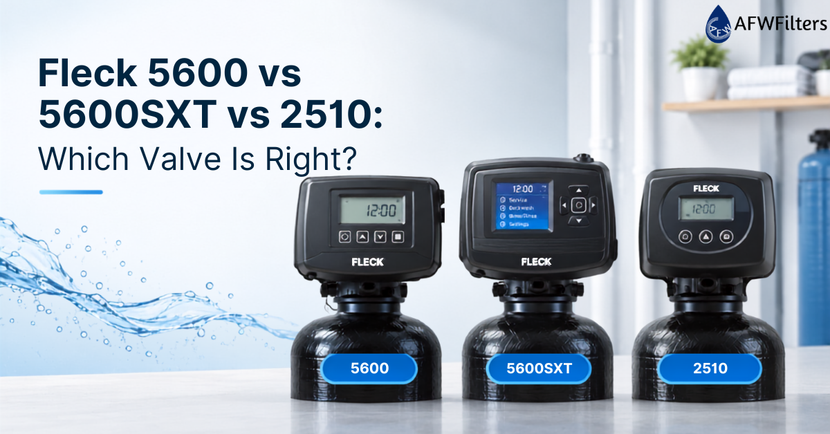
If you have been comparing water softeners, the same three valve names keep appearing: Fleck 5600, Fleck 5600SXT meter, and Fleck 2510. All three are Pentair Fleck valves.
KEY TAKEAWAYS
- 5600SXT fits most homes: metered control cuts salt use versus a basic 5600 time-clock.
- 5600 (time-clock) is best only for predictable use or as a simple filter valve.
- 2510 is for bigger tanks and high backwash needs (up to 16" tanks and 17 GPM backwash).
- Size by tank first: if you need 14–16", you are in 2510 territory.
- 2510 is not a drop-in swap for a 5600; it matches the original platform.
- On well water with iron, use a dedicated iron filter before the softener.
If you have been comparing water softeners, the same three valve names keep appearing: Fleck 5600, Fleck 5600SXT meter, and Fleck 2510. All three are Pentair Fleck valves. All three are proven in residential and light commercial service. And all three make a different trade-off.
The control valve decides when your softener regenerates, and that single decision drives how much salt and water the system consumes for the next fifteen years. This guide covers what separates the three valves, which one fits which house, and what to check before you buy a replacement head.
The Core Difference: Metered vs. Time-Clock Regeneration
A time-clock valve regenerates on a fixed schedule; a metered valve regenerates only after a set volume of water has passed through the resin. Metering is the difference between a softener that runs a cycle every third day whether it needs one or not, and a softener that runs one when the resin is actually exhausted. That is where the salt and water savings come from.
Time-clock regeneration fires on an interval set at programming — every two days, every three days, and so on. It is mechanically simple and completely predictable. It is also blind: a week away from home costs you the same salt as a week with guests.
Metered regeneration counts gallons through a flow meter in the valve body. Once the metered volume reaches the programmed capacity minus reserve, the valve queues a regeneration for the next regeneration time. Two variants exist: meter delayed (waits for the set regeneration time, normally 2:00 a.m.) and meter immediate (regenerates as soon as capacity is used). Residential softeners are almost always meter delayed.
"A time-clock valve is priced lower and costs more. The gap shows up in salt, not on the invoice."
Fleck 5600: The Mechanical Time-Clock Valve
The Fleck 5600 is a mechanically timed valve with no electronics: regeneration is triggered by a cam and timer pins on a fixed day interval. There is no display and no meter. It is the simplest valve Fleck makes for residential softeners, and simplicity is exactly what it is for.
Where it earns its place:
- Almost nothing to fail electronically; the failure modes are mechanical and cheap to fix
- No programming menu — set the time of day and the day pins and it runs
- Decades of field history and universal parts availability
- Lowest cost of the three platforms
Where it falls short:
- Regenerates on schedule whether or not the resin is exhausted
- Cannot adapt to a household that changes size, travels, or has seasonal use
- No feedback on remaining capacity
Best for: households with genuinely steady water use, buyers who want mechanical simplicity, sites with unreliable power, and backwashing filter applications — a sediment, carbon, or Birm filter has no "capacity used" to meter, so a time-clock valve is the correct choice there, not a compromise.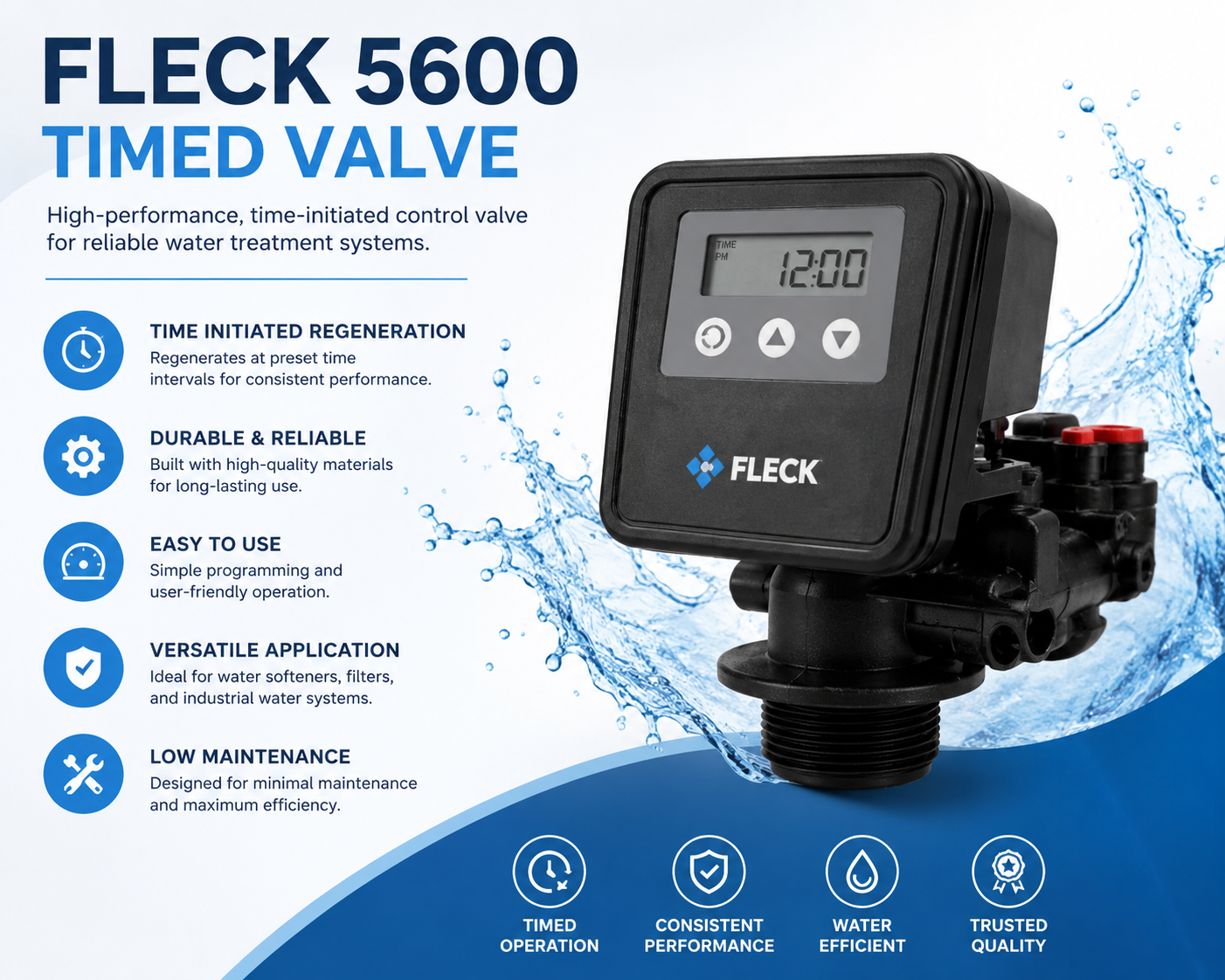
Browse Our Range of Fleck 5600 Timed Valves →
Fleck 5600SXT Meter: The Digital Metered Upgrade
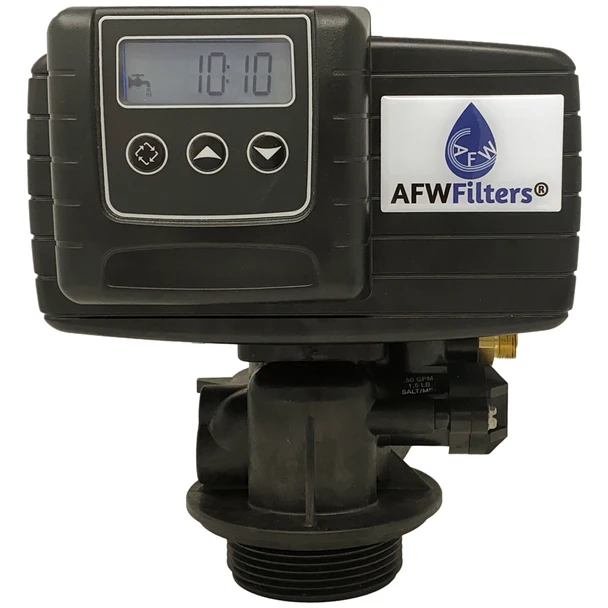
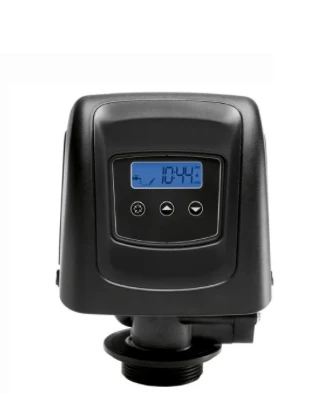
The Fleck 5600SXT is the digital, metered version of the 5600 platform: a paddlewheel meter counts actual gallons and an electronic controller triggers regeneration on demand, typically reducing salt use by 20–30% compared with a time-clock valve on the same tank. It is the valve on most AFW residential softeners from 32,000 through 80,000 grains.
WHAT DOES "SXT" MEAN?
SXT is Pentair's designation for the digital electronic controller fitted to a Fleck valve body — an LCD display, a circuit board, and non-volatile memory replacing the mechanical cam timer. The valve body itself (5600, 2510, 5800) is unchanged; SXT describes the head on top of it. Related designations: XT (earlier digital), SE (electronic timer, no meter), NXT (battery-powered).
What the SXT head adds:
- Demand-initiated regeneration — the softener recharges when capacity is used, not on a calendar
- A live LCD showing time of day, volume remaining before regeneration, and current flow rate
- Menu programming for hardness, capacity, reserve, regeneration time, and day override
- Non-volatile memory — programmed settings are retained indefinitely through a power cut; an internal capacitor keeps time of day running for roughly 48 hours
Correction worth knowing: the "48-hour backup" quoted on many retailer pages refers only to the clock. Your hardness, capacity, and cycle settings are not lost after 48 hours; they are stored permanently. After a long outage you normally only need to reset the time of day.
What metered regeneration is actually worth
Take a four-person household at 15 gpg hardness on a 48,000-grain system. Daily hardness load is roughly 4 people × 75 gallons × 15 gpg ≈ 4,500 grains. Against a usable capacity of about 36,000 grains at an efficient salt dose, a metered valve regenerates roughly every eight days. A time-clock valve set conservatively on a three-day interval regenerates about 122 times a year against the metered valve's 46 — well over twice the salt and more than twice the regeneration water sent to drain.
Over a fifteen-year service life, the metering hardware pays for itself several times over in salt alone.
Best for: most residential softener applications on city or well water, on tanks up to 13" in diameter.
Fleck 2510: High Backwash Capacity and Big Tanks
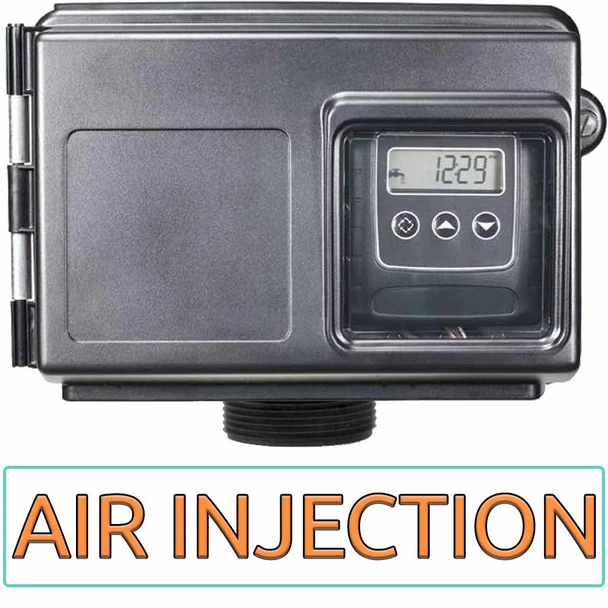
The Fleck 2510 is a high-performance valve rated by Pentair for 19 GPM continuous service flow and up to 17 GPM backwash, and it accommodates softener and filter tanks up to 16 inches in diameter. That backwash figure — not peak service flow — is the reason to specify it.
This is worth being precise about, because it is widely misreported. The 5600SXT is rated up to 20 GPM service flow at a 15 psi pressure drop, so on peak service numbers the two platforms are comparable. What the 5600 platform cannot do is backwash a large-diameter tank. Lifting and rinsing the bed in a 14" or 16" tank takes far more flow than a 13"-max valve can deliver, and a bed that is never properly backwashed fouls.
So the 2510 is the right valve when:
- The system needs a 14" or 16" tank — typically 64,000 grains and above — or a large media filter
- The home has five or more bathrooms with high simultaneous demand and you want continuous flow with minimal pressure drop
- The application is a well water iron, sulphur, or manganese filter needing an aggressive backwash to keep media clean
- It is a light commercial installation
Check your well before you specify a 2510. A 16" tank backwashing at 17 GPM needs a well and pump that can sustain that rate for the full backwash step. A pump that can only deliver 8–10 GPM will not clean the bed properly no matter which valve is on top of it. This is the most common sizing mistake we see on well systems.
Variants: the 2510 is available as a mechanical time-clock, as the digital metered 2510SXT, and as the 2510AIO — an air-injection oxidising head used on iron and sulphur filters rather than softeners.
Compatibility: the 2510 is not a drop-in replacement for a 5600. The valve body, base thread, and connection points differ. If you are replacing a control head on an existing tank, the replacement must match the original platform. Fleck 2510 valves and parts are stocked at AFW for existing 2510 owners.
Full Specification Comparison
Specifications below are Pentair published figures for the valve bodies; grain ranges reflect the tank sizes AFW pairs each valve with.
|
Specification |
Fleck 5600 |
Fleck 5600SXT |
Fleck 2510 |
Fleck 2510SXT |
|
Regeneration trigger |
Time-clock (mechanical) |
Metered, demand-initiated |
Time-clock (electromechanical) |
Metered, demand-initiated |
|
Service flow |
Up to 20 GPM @ 15 psi drop |
Up to 20 GPM @ 15 psi drop |
19 GPM continuous |
19 GPM continuous |
|
Max backwash flow |
Approx. 7 GPM |
Approx. 7 GPM |
17 GPM @ 25 psi drop |
17 GPM @ 25 psi drop |
|
Max tank diameter |
13" |
13" |
16" |
16" |
|
Port sizes |
3/4" – 1" |
3/4" – 1" |
3/4" – 1-1/4" |
3/4" – 1-1/4" |
|
Control / display |
Cam timer, no display |
Digital LCD |
Electromechanical timer |
Digital LCD |
|
Meter |
None |
Paddlewheel |
Optional |
Paddlewheel |
|
Typical AFW grain range |
24k – 48k |
32k – 80k |
48k – 110k |
48k – 110k |
|
Valve body |
Fibre-reinforced polymer |
Fibre-reinforced polymer |
Fibre-reinforced polymer |
Fibre-reinforced polymer |
|
Warranty (AFW) |
5 years |
5 years |
5 years |
5 years |
Which One Is "Best For" What
|
|
Fleck 5600 |
Fleck 5600SXT |
Fleck 2510 / 2510SXT |
|
Best for |
Filters, steady-use homes, mechanical simplicity |
Most residential softeners |
Large tanks, 5+ bathrooms, iron filters, light commercial |
|
Salt efficiency |
Lowest |
Highest |
Matches its control type |
|
Household size |
1–3 |
1–6 |
5+ or high simultaneous demand |
|
Programming |
Timer pins |
Digital menu |
Timer pins or digital menu |
Which Valve for Which Tank Size
Pick the tank first, then the valve. Tank diameter is the hard constraint — the valve has to be able to backwash it.
|
Tank size |
Resin |
Grain capacity |
Valve |
Typical DLFC |
|
8" × 44" |
0.75 cu ft |
24,000 |
5600 / 5600SXT |
1.5 GPM |
|
9" × 48" |
1.0 cu ft |
32,000 |
5600SXT |
2.0 GPM |
|
10" × 54" |
1.5 cu ft |
48,000 |
5600SXT |
2.4 GPM |
|
12" × 52" |
2.0 cu ft |
64,000 |
5600SXT or 2510SXT |
3.5 GPM |
|
13" × 54" |
2.5 cu ft |
80,000 |
5600SXT or 2510SXT |
4.0 GPM |
|
14" × 65" |
3.0 cu ft |
96,000 |
2510SXT |
5.0 GPM |
|
16" × 65" |
3.5–4.0 cu ft |
110,000+ |
2510SXT |
7.0 GPM |
DLFC sizes above are typical for softener resin. Filter media — Filox, Katalox, greensand — backwash at higher rates and use different washers. If in doubt, call 785-661-2241 with your tank size and media type.
What About the 5800SXT, 9100SXT, and Clack WS1?
The 5600SXT is not Fleck's only metered valve; it is the one with the longest field history and the widest parts availability. Three alternatives come up regularly:
- Fleck 5800SXT — functionally very close to the 5600SXT (electronic metered, single piston, comparable service flow) on a newer body. Choose it for the updated design; choose the 5600SXT for the deeper installed base and universal service familiarity.
- Fleck 9100SXT — a twin-tank valve. While one tank is in service the other regenerates, so soft water is available continuously with no hard-water bypass window. Worth it for very hard water or homes that cannot tolerate a night-time gap.
- Clack WS1 — the closest competitor. It carries a higher peak flow rating than the 5600SXT and is a genuinely good valve. The practical trade-off is availability: Fleck parts can be sourced by any plumber and Fleck permits direct-to-homeowner sales, while Clack restricts drop-shipping.
A note on counterfeits. The legitimate Fleck residential lineup is the 5600, 5600SXT, 5800SXT, 2510, 2510SXT, and 9100SXT. Listings for models outside that lineup — a "Fleck 5900," for example — are not Pentair products. Buy from an authorised source and check the Pentair label on the head.
"Nine times out of ten, when someone tells me their softener 'stopped working,' the valve is fine — the hardness setting was never changed from the factory default, or the injector is plugged with iron. Set the valve to your actual water, and put a sediment pre-filter in front of it. That's most of the job." — Mark Bunner, Founder of AFW Filters
Ready to Choose?
Browse whole house water softener systems to compare complete 5600SXT and 2510SXT-equipped systems, or use the softener sizing guide if you are not sure what capacity you need. Replacing a head on an existing system? Replacement parts for both platforms are stocked and ship fast. On well water with iron, start with an iron and sulphur filter ahead of the softener.
Call 785-661-2241 and we will size it against your water test.
Frequently Asked Questions
What is the difference between the Fleck 5600 and the Fleck 5600SXT?
The 5600 is a mechanical time-clock valve that regenerates on a fixed day interval; the 5600SXT is a digital metered valve that regenerates based on measured water use. The SXT typically uses 20–30% less salt because it only regenerates when the resin is actually exhausted, and its LCD shows remaining capacity.
What does SXT stand for on a Fleck valve?
SXT is Pentair's name for the digital electronic controller fitted to a Fleck valve body, replacing the mechanical cam timer with an LCD, a circuit board, and non-volatile memory. The valve body underneath is unchanged.
When should I choose the Fleck 2510 over the 5600SXT?
Choose the 2510 when your system needs a tank larger than 13" in diameter, when you need up to 17 GPM of backwash flow for filter media, when the home has five or more bathrooms with high simultaneous demand, or for light commercial use. Below that, the 5600SXT is the better-value valve.
Is the Fleck 2510 higher flow than the 5600SXT?
Not on peak service flow. Pentair rates the 2510 at 19 GPM continuous and the 5600SXT up to 20 GPM at 15 psi drop. The 2510's real advantage is backwash capacity — 17 GPM versus roughly 7 GPM — which is what lets it support tanks up to 16 inches.
Which Fleck valve is best for well water softeners?
For most residential wells, a 5600SXT on a 48,000 or 64,000-grain system is the right balance of capacity and salt efficiency. Above 30 gpg hardness or with high demand, move to a 2510SXT on 64,000–96,000 grains. If the water contains iron, put a dedicated iron filter ahead of the softener rather than asking the softener to handle it.
How do I know which Fleck valve I already have?
The model is printed on the label on the control head, usually on the front face or the underside of the cover. A mechanical dial with day pins is a 5600 or 2510 time-clock; an LCD screen is an SXT head. If the label is gone, photograph the valve and call 785-661-2241.
Recent Posts
-

Residential Water Softener Systems: How to Choose the Right Size & Type
KEY TAKEAWAYS Most professionals recommend softening above 7 grains per gallon (GPG). Size on …Published Date: Sep 17 2026 -

Water Filter Replacement Schedule: How Often to Change (2026 Guide)
A well-maintained filtration system means better-tasting water, spot-free dishes, and one less thing …Published Date: Aug 30 2026 -
Fleck 5600 vs 5600SXT vs 2510: Which Valve Is Right?
If you have been comparing water softeners, the same three valve names keep appearing: Fleck 5600, F …Published Date: Aug 28 2026