
Understanding Water Filter Replacement Parts: Cartridges, O-Rings & Housings

Replacing a water filter cartridge sounds simple until you're standing in front of your housing with the wrong size in your hand.
KEY TAKEAWAYS
- Softeners treat hardness, not high iron or sulfur odor.
- Resin tolerates ~3–5 ppm ferrous iron; more fouls it.
- Rotten-egg smell = H₂S gas; needs oxidation, not softening.
- Typical fix: iron/sulfur filter first, then softener.
- Test first: size treatment to iron, hardness, and H₂S levels.
Replacing a water filter cartridge sounds simple until you're standing in front of your housing with the wrong size in your hand.
Water filter replacement parts aren't one-size-fits-all: cartridge length, diameter, micron rating, and housing type must all match, and a mismatch can lead to a poor seal, reduced flow, or a leak at the housing cap.
This guide walks through the parts that make up a standard filtration system cartridges, O-rings, housings, and membranes and how to confirm compatibility before you order.
What Parts Make Up a Water Filtration System?
A typical whole house or point-of-use filtration setup has four replaceable components: the filter cartridge itself, the O-ring that seals the housing, the housing (sump) that holds the cartridge, and, for RO systems, one or more membranes. Each part wears differently and follows its own replacement schedule, which is why a single "filter change" often involves more than swapping the cartridge alone.
What Are the Standard Water Filter Sizes?
Most residential and light commercial cartridges fall into one of five standard categories: 5"x2.5", 10"x2.5", 20"x2.5", 10"x4.5" (sometimes called "Big Blue"), and 20"x4.5" ("jumbo"). The first number is cartridge length, the second is diameter. If a housing is labeled standard-size, it will typically accept any cartridge of matching dimensions regardless of brand.
Micron rating is the second number that matters just as much as size. It measures the smallest particle size a cartridge filters out a 5-micron sediment filter, for example, removes finer particles than a 20-micron version. Getting the size right but the micron rating wrong still leaves you with the wrong filter for your water problem.
Quick-Reference Filter Size Cheat Sheet
Not sure which size you need? Use this quick guide to match your housing to the right cartridge.
|
Size |
Typical use |
Notes |
|
5" x 2.5" |
Small under-sink or refrigerator filters |
Shortest standard size; often called "slim-line" |
|
10" x 2.5" |
Most common whole-house and under-sink housing |
Standard size; fits the majority of residential systems |
|
20" x 2.5" |
High-flow or high-capacity whole-house systems |
Longer cartridge = more surface area, less frequent changes |
|
10" x 4.5" |
"Big Blue" high-flow housings |
Wider diameter for higher flow rates; common for whole-house sediment or carbon |
|
20" x 4.5" |
Jumbo high-capacity systems |
Maximum surface area; used where flow and capacity both matter |
How Do You Find Compatible Replacement Filter Cartridges?
Start by checking the brand and model number printed on the housing or the original cartridge; most manufacturers list direct cross-references for their part numbers. If no model number is visible, measure the cartridge itself (length and diameter) and match it to the closest standard size category keeping in mind that a "10-inch" cartridge may measure closer to 9.75 inches in practice. That's still standard.
"Getting the cartridge size right is only half the job. Micron rating and housing brand are what actually determine whether the new filter performs the way the old one did."
Universal vs. OEM Cartridges What's the Difference?
Universal cartridges are built to fit standard housing dimensions across brands, which usually makes them cheaper and easier to source locally. OEM (original equipment manufacturer) cartridges are made specifically for one brand's housing and internal seal design, and are the safer choice when a system has a non-standard cap thread or a proprietary end-cap design.
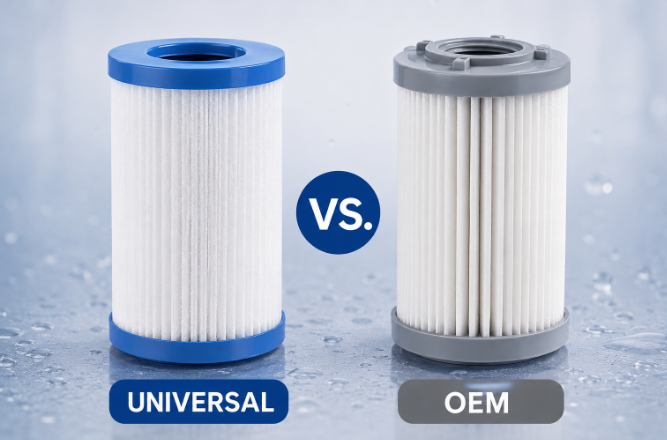
Check out our range cartridge systems
Universal vs. OEM Cartridges At a Glance
|
Feature |
Universal cartridge |
OEM cartridge |
|
Fits standard housing sizes |
Yes, across brands |
Yes, brand-specific |
|
Typical cost |
Lower |
Higher |
|
Availability |
Widely stocked |
Often special-order |
|
Best for |
Standard 10"/20" housings with no proprietary cap |
Systems with a molded or non-standard thread/cap |
|
Risk of mismatch |
Low, if size/micron confirmed |
Very low |
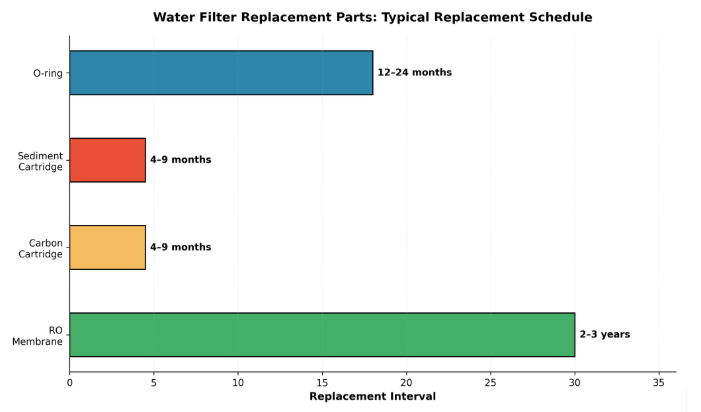
How Often to Replace Each Part
|
Part |
Typical interval |
Sign it's due |
|
Sediment cartridge |
3–6 months |
Noticeable pressure drop at fixtures |
|
Carbon cartridge |
6–12 months |
Chlorine taste or odor returning |
|
Housing O-ring |
Every 1–2 cartridge changes |
Weeping at the cap, or a flattened/cracked ring |
|
RO membrane |
2–3 years |
Slower fill, or rising TDS in the product water |
|
Housing (sump) |
Only on damage |
Crazing, cracks, or a thread that won't seal |
The four signs it's time to change a cartridge, regardless of the calendar: a drop in water pressure, a change in taste or odor, visible discoloration or fouling on the cartridge when you pull it, or simply passing the rated capacity for your water quality. Well water with sediment or iron will shorten every interval above.
When Certification Matters
Beyond size and brand, certification is another factor in choosing replacement parts. NSF certification is an independent verification that a water filter or component meets specific public health and safety standards. NSF International (now NSF) tests products against standards such as:
- NSF/ANSI 42 Aesthetic effects (chlorine, taste, odor, particulates)
- NSF/ANSI 53 Health effects (lead, cysts, VOCs, and other contaminants)
- NSF/ANSI 58 Reverse osmosis systems
- NSF/ANSI 372 Lead-free materials compliance
When a cartridge, housing, or complete system is "NSF certified," it means the product has been tested by a third party and proven to perform as claimed for the contaminants listed on its label.
Filter Housing O-Rings Why They Matter More Than You Think
A filter housing O-ring is the rubber gasket that seals the cap to the housing sump, and it's the most common source of leaks after a cartridge change, not the cartridge itself. O-rings dry out, flatten, or crack over time, especially in housings that sit outdoors or in unheated spaces. Replacing the O-ring every one to two cartridge changes, and lightly lubricating it with silicone grease (never petroleum-based) before reinstalling the cap, prevents most post-change leaks.
"If a housing leaks right after a filter change, the O-ring is the first thing to check, not the cartridge."
Do You Need a Filter Housing Wrench?
A filter housing wrench is a strap or notched tool designed to grip the housing sump so it can be twisted loose without damaging the plastic. Standard 10" and 20" housings are often over-tightened at installation or during regeneration cycles, and hand strength alone isn't enough to break the seal without risking a cracked sump. A properly sized wrench is inexpensive and reduces the risk of needing to replace the entire housing instead of just the cartridge.
Are RO Membranes Replaced the Same Way as Cartridges?
No RO membrane replacement is a separate process from sediment or carbon cartridge changes and follows its own schedule, typically every 2–3 years depending on water quality and usage, compared to the 3–6 month cycle common for sediment pre-filters. RO systems usually stack several cartridge stages (sediment, carbon) ahead of the membrane itself, and each stage has a different replacement interval.
Order the Right Part the First Time
Browse water filter replacement parts cartridges, O-rings, housings and membranes or check Fleck 2510 replacement parts for valve components. Not sure which cartridge you're holding? Call 785-661-2241 with the dimensions and we'll match it.
Frequently Asked Questions
How do I find compatible replacement filter cartridges for my system?
Check the brand and model number on your housing first, since most manufacturers publish cross-reference charts. If no model number is available, measure the cartridge's length and diameter and match it to the closest standard size (10"x2.5", 20"x2.5", 10"x4.5", or 20"x4.5").
What's the difference between universal and brand-specific water filter cartridges?
Universal cartridges fit any housing of the same standard dimensions, regardless of manufacturer, and are usually less expensive. Brand-specific (OEM) cartridges are built for one manufacturer's exact housing and seal design, which matters most for systems with a proprietary cap or thread.
What are the standard water filter housing sizes?
The five most common cartridge sizes are 5"x2.5", 10"x2.5", 20"x2.5", 10"x4.5", and 20"x4.5", with the first number representing length and the second diameter. Housings labeled "standard" typically accept any cartridge matching those dimensions.
Why does my filter housing leak after I change the cartridge?
A worn, dry, or improperly seated O-ring is the most common cause of post-change leaks more often than the cartridge itself. Replace the O-ring periodically and lubricate it with silicone grease before reinstalling the cap.
How often should I replace water filter replacement parts?
Sediment and carbon cartridges typically need replacement every 3–6 months depending on water quality and usage, RO membranes every 2–3 years, and O-rings roughly every one to two cartridge changes.
Do I need a special wrench to change my water filter housing?
A filter housing wrench isn't strictly required, but it makes removing an over-tightened housing significantly easier and lowers the risk of cracking the sump compared to using hand strength alone.
Can I use a universal cartridge in a Fleck-branded system?
For standard-size sediment or carbon housings, a correctly sized universal cartridge generally works. For components with proprietary caps or threads, confirming compatibility with a Fleck 2510 replacement parts cross-reference or using OEM parts is the safer route.
Recent Posts
-

Understanding Water Filter Replacement Parts: Cartridges, O-Rings & Housings
Replacing a water filter cartridge sounds simple until you're standing in front of your housing with …Published Date: Oct 14 2026 -

Water Softener Installation: Cost, Steps and DIY Guide
Your softener has arrived and it is sitting in a box in the garage. Now what? Installation is where …Published Date: Oct 5 2026 -

Residential Water Softener Systems: How to Choose the Right Size & Type
There is a real difference between water that simply comes out of the tap and water that actually fe …Published Date: Sep 17 2026