
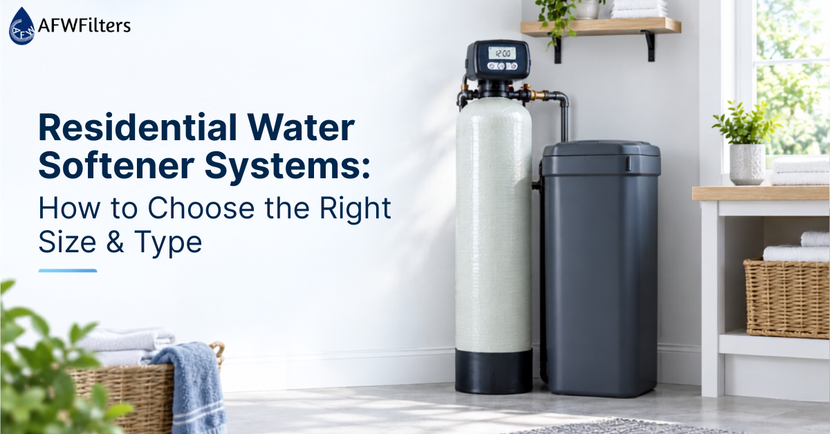
Residential Water Softener Systems: How to Choose the Right Size & Type
KEY TAKEAWAYS
- Most professionals recommend softening above 7 grains per gallon (GPG).
- Size on compensated hardness adds roughly 4 GPG for every 1 ppm of iron before you calculate.
- The formula: people × 75 gallons × compensated GPG × 7 days = weekly grain requirement.
- Undersizing is the most common mistake. It forces near-daily regeneration, wastes salt, and shortens resin life.
- Choose metered regeneration over timer-based, and 10% crosslink resin over 8% on chlorinated water.
There is a real difference between water that simply comes out of the tap and water that actually feels good to use - softer on your skin, gentler on every appliance it touches. A quality residential water softener is what makes that difference, and getting one set up correctly is far simpler than most homeowners expect.
The trick is not finding the fanciest system on the market. It is matching the right size and type to your household, your water, and
how you actually use it. Get that match right, and you stop thinking about your water altogether. This guide walks through exactly how to make it from spotting hard water to sizing a system that still fits your home in ten years.
Signs of Hard Water in Your Home
Before shopping for a system, confirm hard water is actually the culprit. Look for:
- White, chalky limescale buildup on faucets, showerheads, and around drains
- Soap and shampoo that will not lather, even with more product
- Spots or film on dishes and glassware straight out of the dishwasher
- Dry skin or dull, stiff-feeling hair after washing
- Faded, scratchy laundry, even with a full detergent dose
- Reduced water pressure over time, as scale narrows the pipe diameter
If two or three of these sound familiar, hard water is very likely behind it.
How Do I Know If I Need a Water Softener at Home?

The signs above are a strong starting point, but a hardness test gives you a number to work with. Hardness is measured in grains per gallon (GPG):
|
Classification |
GPG |
What It Means for You |
|
Soft |
Under 1.0 |
No treatment needed |
|
Slightly hard |
1.0 – 3.5 |
Rarely worth softening on hardness alone |
|
Moderately hard |
3.5 – 7.0 |
Borderline softening helps but is not essential |
|
Hard |
7.0 – 10.5 |
Softening recommended; scale and soap problems become obvious |
|
Very hard |
10.5+ |
Softening strongly recommended; appliance life is measurably affected |
You can test with a home strip kit, a lab test, or by checking your municipal supplier's annual water quality report. On well water, a lab test is worth the small cost; you need iron and manganese figures too, and strips will not give you those.
Before You Size: Compensated Hardness
This is the step most sizing guides skip, and skipping it is why so many softeners underperform. If your water contains iron or manganese, the softener has to deal with those too, and they consume capacity that your hardness number does not account for.
|
What You Have |
Add to Your GPG |
Example |
|
Hardness |
Your tested GPG |
10 GPG |
|
Iron |
About 4 GPG per 1 ppm of iron |
1.5 ppm iron → add ~6 GPG |
|
Manganese |
About 4 GPG per 1 ppm of manganese |
0.5 ppm → add ~2 GPG |
|
Compensated hardness |
The total use this figure to size |
10 + 6 + 2 = 18 GPG |
Above 3 ppm of iron, size differently
Compensating works for light iron. Above roughly 3 ppm, a softener alone will foul too fast regardless of how you size it; you need a dedicated iron filter installed upstream. See our whole-house iron filter buying guide for sizing.
Water Softener Sizing Chart by Household Size
Sizing comes down to a simple formula: people in the home × 75 gallons per day × compensated hardness in GPG = your daily grain requirement. Multiply by 7 for a weekly target, then round up to the nearest standard system size.
|
Household |
Moderate (under 7 GPG) |
Hard / Very Hard (7+ GPG) |
Resin Volume |
|
1–2 people |
24,000 grain |
32,000 grain |
0.75 – 1.0 cu ft |
|
3–4 people |
32,000 – 40,000 grain |
48,000 grain |
1.0 – 1.5 cu ft |
|
5+ people |
48,000 – 64,000 grain |
64,000 – 96,000 grain |
1.5 – 3.0 cu ft |
As a rule of thumb, one cubic foot of standard resin gives roughly 32,000 grains of capacity. That conversion lets you cross-shop systems whether they are specified in grains or cubic feet.
What Size Water Softener Do I Need for a Family of 5?
Let us run the numbers. A family of five on moderately hard water at 7 GPG needs:
5 people × 75 gallons/day × 7 GPG = 2,625 grains per day
2,625 × 7 days = 18,375 grains per week
A 32,000-grain system covers that with room to spare, regenerating roughly every twelve days, which is comfortable. A 24,000-grain system would regenerate closer to every nine days, which works but leaves little headroom for laundry-heavy weeks or guests. That is why a 32,000–40,000-grain system is the better fit here.
On harder water at 10+ GPG, the same household needs closer to 26,000 grains a week, and sizing up toward 48,000–64,000 grains avoids regenerating too frequently.
Undersizing is the single most common mistake. A system that is too small regenerates almost daily, wasting salt, wasting water, and shortening resin life.
Softener Capacity Calculator: Do the Math Yourself
Want to check your own numbers? Work through these five steps:
- Count your household size: everyone living in the home full-time.
- Multiply by 75 the average gallons used per person per day.
- Multiply by your compensated hardness in GPG, plus any iron and manganese adjustment from the table above.
- Multiply by 7 for your weekly grain requirement.
- Round up to the nearest standard system size, adding a buffer if you are near a size boundary or your household size is likely to grow.
Don't Forget Service Flow Rate
Grain capacity tells you how long between regenerations. Service flow rate (SFR) tells you whether the system keeps up when the shower, dishwasher, and washing machine all run at once. A correctly sized system needs both.
|
Household / Fixtures |
Typical Peak Demand |
Minimum SFR to Look For |
|
1–2 people, 1 bathroom |
Around 5–7 GPM |
7 GPM |
|
3–4 people, 2 bathrooms |
Around 8–10 GPM |
10 GPM |
|
5+ people, 3+ bathrooms |
Around 11–15 GPM |
12–15 GPM |
Types of Residential Water Softeners
|
Type |
How It Works |
Best For |
|
Single-tank, metered |
Regenerates based on actual water use, tracked by a meter |
Most households' standard, efficient choice |
|
Single-tank, timer-based |
Regenerates on a fixed schedule regardless of use |
Less common today; wastes more salt and water |
|
Dual-tank |
One tank stays in service while the other regenerates |
Large households, or anyone who cannot have downtime |
|
Fine mesh resin |
Denser resin built to also handle low levels of dissolved iron |
Well water with light iron alongside hardness |
|
Upflow brining |
Brine is drawn upward through the bed, contacting the most-depleted resin first |
Households prioritising salt efficiency |
Salt-Based vs. Salt-Free: An Honest Comparison
Salt-free "conditioners" (usually template-assisted crystallisation, or TAC) are widely cross-shopped against softeners. They are not the same product, and the difference matters.
|
|
Salt-Based Softener |
Salt-Free Conditioner (TAC) |
|
What it does |
Removes calcium and magnesium from the water via ion exchange |
Leaves the minerals in the water but alters them so they are less likely to form scale |
|
Water feel |
Noticeably softer, better lather, softer skin and laundry |
Feels the same as untreated water |
|
Scale protection |
Yes, hardness minerals are gone |
Reduces scale formation, but does not remove hardness |
|
Spotting on glassware |
Eliminated |
Usually still present |
|
Salt and regeneration |
Requires salt and a drain |
No salt, no drain, no regeneration |
|
Best for |
Anyone who wants genuinely soft water |
Homes with no drain access, or where sodium must be avoided entirely |
If you want water that feels soft and eliminates spotting, you want a salt-based softener. If your priority is scale protection with no salt and no drain, a conditioner is a legitimate choice; just go in knowing it will not change how the water feels.
Choosing Quality Water Softener Systems: What to Look For
- Metered (demand-initiated) regeneration over timer-based, since it saves salt and water automatically.
- 10% crosslink resin over standard 8%. Crosslink refers to the density of the resin's internal structure; higher crosslink resists chlorine breakdown better and lasts longer, which matters most on municipal water.
- A proven control valve platform with widely available parts. Fleck valves such as the 5600SXT and 2510 are the benchmark here; parts are available years down the road, and repairs are straightforward rather than requiring a proprietary service call.
- Good salt efficiency is measured as grains removed per pound of salt. It is the difference between a system that costs little to run and one that quietly costs a lot.
- Certification NSF/ANSI 44 or a WQA Gold Seal indicates independent verification of performance claims.
Browse our full range of quality water softener systems to compare sizes and types side by side, or use our softener sizing tool if you would rather work from your numbers directly.
Frequently Asked Questions
What size water softener do I need for a family of 5?
For moderately hard water around 7 GPG, a family of five needs roughly 18,375 grains of weekly capacity, which points to a 32,000–40,000-grain system regenerating about every twelve days. On harder water above 10 GPG, sizing up to 48,000–64,000 grains avoids regenerating too often.
How do I know if I need a water softener at home?
Watch for limescale on fixtures, soap that will not lather, spotty dishes, dry skin or hair after washing, and faded laundry. A hardness test confirms it; most professionals recommend softening above 7 GPG.
What is the difference between a metered and timer-based regeneration cycle?
A metered system regenerates based on actual water use, saving salt and water. A timer-based system regenerates on a fixed schedule whether it is needed or not, which wastes both on lighter-use weeks.
How does ion exchange actually remove hardness from water?
As hard water passes through the resin tank, resin beads swap calcium and magnesium ions for sodium or potassium ions. Once the resin's capacity is used up, a regeneration cycle flushes it with brine to recharge it for continued use.
Can I install a water softener myself?
Many homeowners do. You need a drain within reach, a way to tie into the main line with a bypass, and power at the install point. If your plumbing requires cutting and soldering copper, or your install location has no drain, a plumber is the better call.
How long does a residential water softener system last?
Quality control valves typically last 15–20 years, and resin 10–15 years under normal conditions, a bit less on heavily chlorinated water with standard 8% resin. Choosing 10% crosslink resin from the start extends that window.
Recent Posts
-
Residential Water Softener Systems: How to Choose the Right Size & Type
KEY TAKEAWAYS Most professionals recommend softening above 7 grains per gallon (GPG). Size on …Published Date: Sep 17 2026 -

Water Filter Replacement Schedule: How Often to Change (2026 Guide)
A well-maintained filtration system means better-tasting water, spot-free dishes, and one less thing …Published Date: Aug 30 2026 -
Fleck 5600 vs 5600SXT vs 2510: Which Valve Is Right?
If you have been comparing water softeners, the same three valve names keep appearing: Fleck 5600, F …Published Date: Aug 28 2026