
Iron Filter vs. Water Softener: Which One Do You Actually Need?
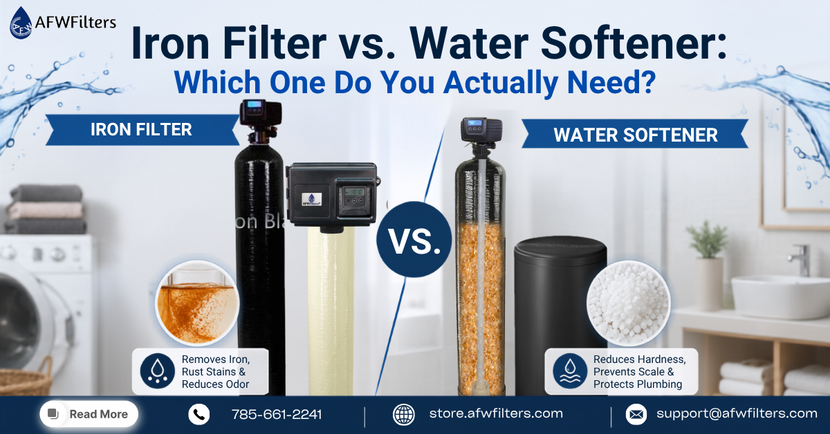
Compare iron filters and water softeners to understand which system best solves your well water problems.
You walk into your bathroom, and the toilet bowl has that familiar reddish-brown ring around it. Or maybe it's the opposite problem: your shower head is caked with white scales, your dishes come out of the dishwasher spotted, and your skin feels dry and tight after every shower. Two different problems. Two different causes. And critically, two different solutions.
This is the question AFWFilters hears from well water homeowners more than almost any other: Do I need an iron filter or a water softener? The confusion is understandable, as both involve large tanks that treat all the water entering your home. But they work in fundamentally different ways; they solve fundamentally different problems, and putting the wrong one in place or using one where you need the other is an expensive mistake that many homeowners make.
What Each System Actually Does?
What a Water Softener Does
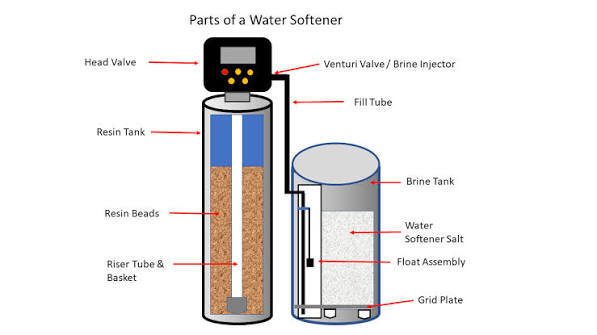
A water softener removes hardness minerals such as calcium and magnesium through the ion exchange process. Hard water flows through a tank filled with resin beads that carry a negative charge. Calcium and magnesium ions, which are positively charged, cling to those beads and are pulled out of the water. Sodium ions take their place, and soft water flows out the other end. The resin periodically regenerates by flushing with a salt brine solution, which strips the captured minerals away and resets the beads for the next cycle.
What an Iron Removal Water Filter Does
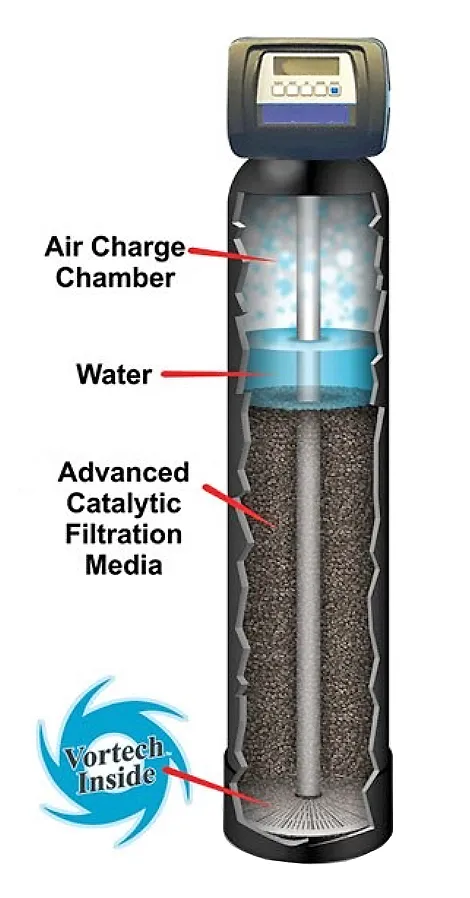
A dedicated iron removal water filter is built for one job: eliminating iron from your water supply. Air injection systems like the AIS Silver, Gold, and Platinum series at AFW maintain a pressurized air pocket inside the filter tank. As well, water passes through that air pocket; dissolved ferrous iron (Fe²⁺) oxidizes into ferric iron (Fe³⁺), converting from an invisible dissolved state into solid particles. Those particles are then trapped by the filter media and flushed away during an automatic daily backwash cycle.
The Key Differences at a Glance
|
Water Softener |
Iron Filter |
|
|
Primary purpose |
Removes hardness (calcium & magnesium) |
Removes iron, manganese, sulfur |
|
Iron removal limit |
Up to ~3 ppm ferrous iron only |
10–20+ ppm depending on media |
|
Handles sulfur odor |
No |
Yes (Gold/Platinum series) |
|
Treatment method |
Ion exchange (salt regeneration) |
Oxidation + backwash (no chemicals) |
|
Treats ferric iron |
No damages resin |
Yes |
|
Treats hard water |
Yes primary function |
No |
|
Salt required |
Yes ongoing |
No |
How to Know Which One You Need
The answer starts with a water test. A basic water test will tell you your iron level in ppm, whether your iron is ferrous (dissolved, clear water) or ferric (particulate, red water), your water hardness in grains per gallon (GPG), and if hydrogen sulfide or manganese are present. With those numbers in hand, the decision becomes straightforward.
You Need a Water Softener If:
- Your water test shows hardness above 7 GPG and iron below 1 ppm
- You're experiencing scale buildup on appliances, faucets, and fixtures
- Dishes are spotted or cloudy after coming out of the dishwasher
- Soap doesn't lather well, and skin feels dry after bathing
- There are no rust-colored stains and no rotten egg smell
You Need an Iron Filter If:
- Iron tests above 3 ppm are the threshold at which softener resin begins to foul
- You see reddish-orange stains on toilets, sinks, tubs, or laundry
- Your water has a metallic taste
- You notice black or dark staining (manganese) or a rotten egg smell (hydrogen sulfide)
- Your water is visibly red or brown when it comes out of the tap
You Need Both If:
This is the situation many well water homeowners find themselves in. If your water test shows both significant iron and hard water minerals, you need both systems, and the installation order matters. The iron filter always goes first. Running iron-laden water through a softener fouls the resin bed, reduces regeneration efficiency, and can permanently damage the system. Run the water through the iron filter first, then the softener. The softener provides clean, iron-free water and performs exactly as designed.
Why AFWFilters
AFWFilters Abundant Flow Water Systems Inc., founded in 1998 in Kansas, has spent over 25 years helping homeowners across the US make exactly this kind of decision correctly. Their team doesn't just sell systems; they help you read your water test, understand what's actually in your water, and configure the right solution for your home's specific situation. Whether that's an Air Injection Silver system for moderate iron, a Platinum series for a severely contaminated well, an Iron Pro combination unit for homes with both iron and hardness, or a dedicated softener for a pure hard water problem, AFW carries the right equipment and the expertise to match it to your needs.
As a member of the Water Quality Association and the Better Business Bureau, and with thousands of verified customer reviews highlighting the quality of both its products and its after-sales support, AFW is the kind of company that's still available when you have a question six months after your system ships. That matters when you're making a long-term investment in your home's water quality.
Frequently Asked Questions
-
Can a water softener replace an iron filter?
Not for iron levels above 3 ppm. A water softener can remove small amounts of dissolved ferrous iron as a side effect of the ion exchange process, but it's not built for it.
-
What happens if iron fouls a water softener's resin?
Iron-fouled resin loses its ability to exchange hardness ions effectively, meaning the softener regenerates more frequently, consumes more salt, and still delivers poor results.
-
Does an iron filter also soften water?
No. An air injection iron filter removes iron, manganese, and hydrogen sulfide through oxidation; it does not affect calcium or magnesium hardness at all. If your water test shows both elevated iron and significant hardness, you need both systems.
-
My water smells like rotten eggs. Is that an iron problem or a sulfur problem?
That smell is hydrogen sulfide gas, a sulfur compound, not iron. However, iron and hydrogen sulfide commonly occur together in well water, particularly in wells with anaerobic (low-oxygen) groundwater conditions. A water softener will not address the odor.
-
How do I know which AFW system is right for my specific water?
Start with a water test. Once you have your results for iron level, hardness, pH, and any sulfur or manganese readings, the AFW Filters team can help you interpret those numbers and match them to the right system configuration.
Recent Posts
-

Understanding Water Filter Replacement Parts: Cartridges, O-Rings & Housings
Replacing a water filter cartridge sounds simple until you're standing in front of your housing with …Published Date: Oct 14 2026 -

Water Softener Installation: Cost, Steps and DIY Guide
Your softener has arrived and it is sitting in a box in the garage. Now what? Installation is where …Published Date: Oct 5 2026 -

Residential Water Softener Systems: How to Choose the Right Size & Type
There is a real difference between water that simply comes out of the tap and water that actually fe …Published Date: Sep 17 2026