
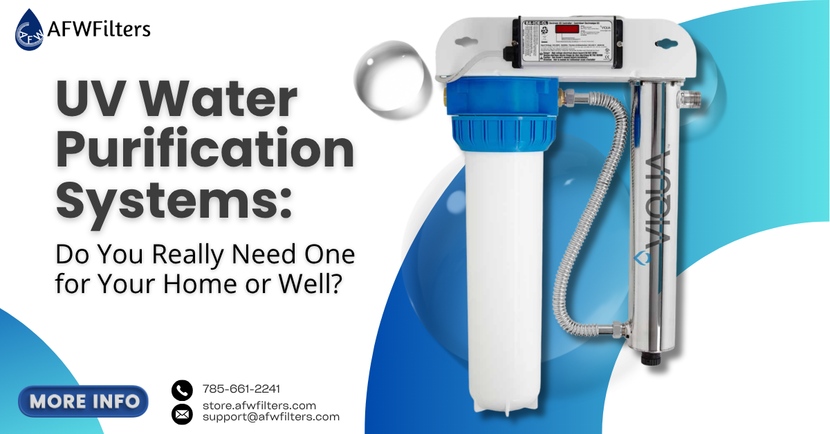
UV Water Purification Systems: Do You Really Need One for Your Home or Well?

Your well water looks clean. It tastes fine. There's no odor, no discoloration, nothing that would make you think twice about filling a glass. But the most dangerous things in well water are almost always invisible.
The CDC estimates that at least 1.1 million Americans get sick from germs in their drinking water every year. For the roughly 43 million US households on private wells, water that is entirely unregulated under the federal Safe Drinking Water Act, the risk is substantially higher.
This is exactly the problem a UV water purification system was built to solve. No chemicals. No change to your water's taste. No complicated maintenance schedule. Just a quiet, reliable layer of protection running in the background every time someone turns on a tap.
What Is a UV Water Purification System and How Does It Work?
UV stands for ultraviolet, specifically, UV-C light at a wavelength of 254 nanometers. At that wavelength, ultraviolet light penetrates the cell walls of microorganisms and directly disrupts their DNA. An organism with damaged DNA can't reproduce, and an organism that can't reproduce can't infect you. The water itself isn't chemically altered. There's no residual disinfectant added. Nothing is removed or added to the water at all; the pathogens are simply rendered harmless as they flow past the UV lamp.
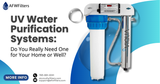
A residential UV disinfection system for home installation consists of four core components:
- A stainless steel reactor chamber where the water flows, and UV exposure occurs
- A UV lamp contained inside the chamber, emitting germicidal UV-C light continuously
- A quartz sleeve is a protective transparent tube that keeps the lamp dry while allowing UV light to pass through into the water
- A controller is a digital unit that monitors lamp life, power output, and in monitored systems, real-time UV dose
Also Read: Hard Water Myths Kansas Homeowners Still Believe (And Why They’re Expensive)
What Does UV Treatment Actually Destroy?
This is one of the most important questions to ask because a bacteria-removal water filter using UV technology has a clear, defined scope. It handles biological contaminants exceptionally well. It handles nothing else. Understanding both sides of that equation is essential before making a purchase decision.
What UV Destroys
A properly sized UV system delivers a minimum dose of 30–40 mJ/cm², the industry-standard threshold at which the following pathogens are effectively neutralized:
- E. coli and coliform bacteria are the most common microbial concerns in private wells
- Giardia and Cryptosporidium are protozoan parasites that are chlorine-resistant and can cause severe gastrointestinal illness
- Viruses, including norovirus, rotavirus, and hepatitis A
- Legionella, the bacteria responsible for Legionnaires' disease
- Salmonella, Listeria, and a broad range of other pathogenic bacteria

UV vs. Chlorination: Why More Homeowners Are Choosing UV
For decades, chlorine injection was the go-to solution for biological contamination in private wells. It works, but it comes with trade-offs that many homeowners are no longer willing to accept. A side-by-side comparison tells the story clearly:
|
UV Disinfection |
Chlorine Injection |
|
|
Chemicals required |
None |
Ongoing chemical supply |
|
Changes water taste or odor |
No |
Yes chlorine residual |
|
Effective against Cryptosporidium |
Yes |
No chlorine-resistant |
|
Ongoing operating cost |
Annual lamp (~$50–150) |
Continuous chemical cost |
|
Harmful disinfection byproducts |
None |
Trihalomethanes (THMs) are possible |
|
Maintenance complexity |
Low annual lamp change |
Higher pumps, chemical dosing |
|
EPA-approved for residential use |
Yes |
Yes |
Chlorine has its place, particularly in cases of bacterial iron or recurring biological contamination where a residual disinfectant is needed throughout the pipe system. But for straightforward microbial protection at the point of entry, the whole-house UV water filter is cleaner, simpler, and increasingly the preferred choice for US well water homeowners.
Choosing the Right UV System: What the Numbers Actually Mean
Shopping for a UV system means encountering a few technical terms that sound more complex than they are. Here's what matters:
UV Dose: 30 mJ/cm² vs. 40 mJ/cm²
UV dose is the measure of how much ultraviolet energy the water receives as it passes through the chamber. The industry standard for general disinfection is 30 mJ/cm². For well water applications, Class A certification at 40 mJ/cm² is the benchmark to look for.
Class A vs. Class B
NSF Class A systems are certified to disinfect water of unknown or unsafe quality, the right choice for private wells. Class B systems (16 mJ/cm²) are certified only for supplemental treatment of water already confirmed safe, such as municipal water where UV is added as a secondary precaution.
Flow Rate (GPM)
Every UV system has a maximum flow rate at which it delivers its rated dose. Run more water through it faster, and the dose drops. Size the system based on your home's peak demand, not your average usage. As a general guide: a 1–2-bathroom home needs around 7–10 GPM; a 3–4-bathroom home needs 12–18 GPM.
UV Transmittance (UVT)
UV light travels through clear water easily. Iron, tannins, turbidity, and other dissolved substances absorb UV light and reduce its penetrating power. A system rated at 18 GPM in standard clear water may only safely treat 12–14 GPM if your well water has low transmittance.
Who Actually Needs a UV System?
The honest answer is: more homeowners than realize it. Here's a practical checklist:
You almost certainly need UV if:
- Your home is on a private well (no municipal water treatment or oversight)
- Have you ever had a positive coliform or E. coli test result
- Your well is shallow (under 50 feet), near agricultural land, septic systems, or flood-prone areas
- You've recently had your well worked on, repaired, or drilled
- You have young children, elderly family members, or anyone with a compromised immune system in your household
- You've experienced unexplained gastrointestinal illness that could be water-related
UV Systems + Water Softeners: Do You Need Both?
This question comes up almost as often as "do I need UV at all," and for most well water homes, the answer is yes; the two systems aren't competing for the same job.
A water softener deals with the mineral side of well water: dissolved calcium and magnesium that cause scale on fixtures, cloudy glassware, and laundry that never quite feels clean. What it doesn't do is touch bacteria, viruses, or parasites. UV handles that side exclusively, neutralizing microbial contamination without removing or altering anything else in the water. Install one without the other and you've only solved half of what well water typically presents.
There's a practical reason to run them together, too. Hardness minerals can build up scale inside a UV reactor chamber over time, coating the quartz sleeve and quietly reducing how much UV light reaches the water without any visible warning sign. Placing the softener upstream of the UV unit protects that performance and extends the sleeve's working life, while the UV system makes sure the softened water reaching your taps is also microbiologically safe.
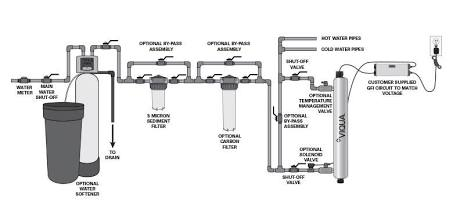
For a typical 1–2-bathroom home, AFW pairs a Viqua Sterilight VH200 UV system, rated to treat up to 9 GPM at the industry-standard 30 mJ/cm² dose, with a 32k or 48k grain softener sized for the same household. That gives you scale protection and microbial disinfection from one point-of-entry setup, rather than sourcing and sizing two separate systems on your own. For larger homes with more than 2 bathrooms, the Viqua VH410 UV system is the most popular choice.
Why Choose AFW Filters for Your UV System
AFW Filters Abundant Flow Water Systems Inc. has been helping US homeowners solve water quality problems since the company was founded in 1998 in Pfeifer, Kansas. Over more than 25 years in business, AFW has worked with thousands of customers across the country, treating everything from hard water and iron staining to sulfur odors, sediment, nitrates, arsenic, PFAS contamination, and pH imbalances. That range of experience means their team has likely already seen a water problem similar to yours and knows what actually fixes it.
The company was built on a simple formula: good products, honest pricing, and customer service that doesn't disappear after the sale. That last part shows up consistently in their reviews, where customers point to responsive, knowledgeable support as the reason they'd buy from AFW again.
As a verified Viqua dealer, AFW supplies authentic Viqua systems with full manufacturer warranty coverage. Their team can help you interpret a water test result and match it to the right UV series, the right flow rate, and the right pre-filtration combination, not just add items to a cart. If questions come up during installation, their support staff is reachable and responsive, and that post-sale follow-through is one of the things customers mention most often in verified reviews.
AFW is a member of the Water Quality Association and the Better Business Bureau. They stock genuine OEM replacement lamps, sleeves, and controllers for every Viqua model they carry, so when it's time for your annual lamp change, you're not searching the internet for the right part number. It's all in one place, at pricing that makes sense.
Frequently Asked Questions
-
Will a UV system change the taste or smell of my water?
No and this is one of its most practical advantages. Unlike chlorination, UV treatment adds nothing to the water and removes nothing from it. The only thing that changes is the microbiological safety of the water.
-
How often do I need to replace the UV lamp?
Once per year, as a general rule. Most residential UV lamps are rated for approximately 9,000 hours of operation, just over one year of continuous use. The lamp doesn't suddenly stop working; it slowly loses intensity.
-
Do I need a pre-filter before my UV system?
In most well water applications, yes. UV light only disinfects water it can reach. Turbidity, iron, and other suspended particles can physically shield microorganisms from UV exposure.
-
Is a whole house UV system the same as a point-of-use UV filter?
No, and the difference matters. A whole-house UV water filter is installed at the point of entry, treating all water before it reaches any tap, shower, or appliance in the home. A point-of-use UV filter treats only the water at a single tap, typically the kitchen sink or drinking water line.
Recent Posts
-
Air Injection Iron Filter: The Chemical-Free Fix for Iron, Sulfur, and Manganese in Well Water
You fill a glass of water from your kitchen tap and hold it up to the light. It looks fine, maybe s …Jul 22 2026 -
Fleck 5600SXT Water Softener: Everything You Need to Know Before You Buy
Hard water is one of those problems that sneaks up on you. You notice the white crust forming aroun …Jul 20 2026 -
UV Water Purification Systems: Do You Really Need One for Your Home or Well?
Your well water looks clean. It tastes fine. There's no odor, no discoloration, nothing that would …Jul 20 2026